Custom website development: tailored solutions for growth

Generic templates limit your business potential. While over 50% of small businesses still rely on cookie-cutter platforms, companies with custom websites consistently outperform competitors in user engagement, conversion rates, and brand differentiation. Custom website development aligns your digital presence with unique business goals, creating experiences that resonate with your specific audience and drive measurable growth.
Key takeaways
| Point | Details |
|---|---|
| Custom development definition | Fully tailored design and coding that matches your specific business needs and brand identity, unlike template platforms. |
| Main benefits | Improved SEO performance, seamless marketing tool integration, enhanced user engagement, and competitive brand differentiation. |
| Cost and timeline realities | Projects typically range 3-6 months with better long-term ROI than templates despite higher initial investment. |
| Partner selection criteria | Evaluate industry experience, technological expertise, communication transparency, and proven ROI through case studies. |
| Implementation best practices | Use phased delivery, ensure responsive design, integrate SEO early, and maintain close team communication throughout. |
Understanding custom website development
Custom website development means building your site from scratch to meet your exact business requirements. Unlike drag-and-drop builders or pre-made themes, custom development involves dedicated coding, unique design elements, and functionality tailored exclusively to your brand and goals.
Three core features define custom websites. First, bespoke layouts reflect your brand identity without generic constraints. Second, unique functionality addresses specific customer needs your competitors can’t replicate. Third, scalability allows growth without platform limitations or costly migrations.
Template platforms offer convenience but sacrifice flexibility. You inherit design limitations, generic user experiences, and restricted customization options. Custom sites eliminate these barriers, giving you complete control over every element from navigation structure to checkout processes.
Aligning your website with business goals requires this level of control. When your site architecture matches how customers actually interact with your brand, engagement increases naturally. Compare custom vs template websites to understand which approach fits your growth strategy.
Key benefits of custom website development
Custom websites transform how users interact with your brand. Tailored navigation paths reduce friction, keeping visitors engaged longer and guiding them toward conversion points. Businesses report 40-60% increases in average session duration after switching from templates to custom solutions.

SEO performance improves dramatically with clean, optimized code. Custom development eliminates bloated template scripts that slow page loads. Search engines reward faster sites with better rankings, directly impacting organic traffic growth.
Integration capabilities deliver the most significant ROI boost. Integrating custom-developed websites with SEO, PPC, and AI-driven automation increases lead generation by over 50% compared to standalone sites. This synergy between your website and digital marketing strategy creates compounding returns.
Key advantages include:
- Seamless data flow between your site and marketing platforms
- Personalized user experiences driven by behavior tracking
- Automated lead nurturing that converts visitors into customers
- Real-time analytics integration for faster decision making
Brand differentiation becomes your competitive advantage. Custom design communicates professionalism and attention to detail that templates cannot match. When prospects compare your site to competitors using generic themes, your investment in quality becomes immediately apparent.
AI marketing strategies integrate naturally into custom platforms, enabling predictive analytics and personalized content delivery that template sites struggle to support.
Common misconceptions about custom website development
Myth one claims custom websites always cost significantly more than templates. Initial investment is higher, but total cost of ownership over three to five years often favors custom development. You avoid recurring theme licenses, plugin subscriptions, and expensive workarounds for missing features.
Myth two suggests custom sites demand constant costly updates. Reality contradicts this assumption. Modular architecture reduces maintenance expenses by up to 40% compared to template sites requiring multiple plugin updates. Clean code means fewer compatibility issues and security vulnerabilities.
Myth three portrays custom development as painfully slow and complex. Typical projects span three to six months with phased deliveries providing usable features early. Modern development methodologies prioritize iterative progress over lengthy delays.
Common timeline concerns include:
- Planning and requirements gathering (2-3 weeks)
- Design mockups and revisions (3-4 weeks)
- Development and feature implementation (8-12 weeks)
- Testing, refinement, and launch preparation (2-3 weeks)
Pro Tip: Invest substantial time in requirements gathering before development starts. Clear specifications prevent scope creep and timeline extensions, saving money and frustration later.
Fear of vendor lock-in worries some businesses. Quality custom development uses standard technologies and provides full code ownership, ensuring you can transition to new developers if needed without rebuilding from scratch.
Cost, timeline, and technology considerations for US and UK businesses
Budget expectations vary by project scope and business size. Small business custom sites typically range from $15,000 to $40,000 in both US and UK markets. Medium-sized businesses investing in complex functionality should expect $40,000 to $100,000 or more.
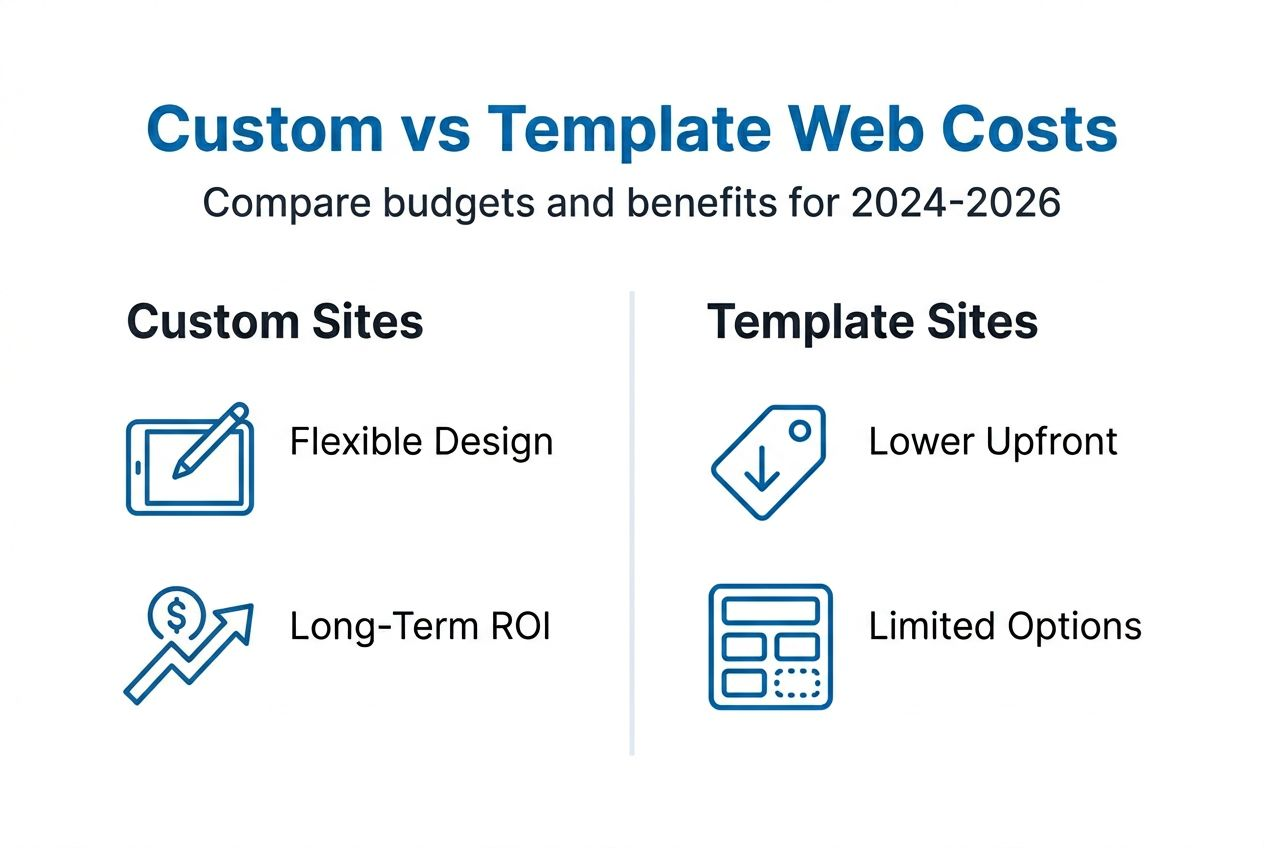
Timeline expectations align with budget tiers. Simpler projects deliver in three to four months, while enterprise solutions require five to eight months. Phased delivery models let you launch core features first, then add advanced functionality in subsequent releases.
Popular technology stacks in US and UK markets include:
- React or Angular for dynamic front-end experiences
- Node.js or Python for scalable back-end systems
- WordPress or custom CMS solutions for content management
- Cloud hosting on AWS, Google Cloud, or Microsoft Azure
| Factor | Custom Development | Template Solution |
|---|---|---|
| Initial Cost | $15,000-$100,000+ | $500-$5,000 |
| Timeline | 3-6 months | 1-4 weeks |
| Scalability | Unlimited growth potential | Platform-dependent limits |
| Maintenance | Modular, predictable costs | Plugin conflicts, frequent updates |
| Brand Differentiation | Unique identity | Generic appearance |
Understanding custom vs template website costs helps set realistic expectations. Your website development costs in 2026 depend on feature complexity, integration requirements, and ongoing support needs.
Development partners offering transparent pricing models deserve priority consideration. Fixed-price contracts work well for clearly defined projects, while time-and-materials agreements suit evolving requirements. Research choosing a web development company thoroughly before committing.
Framework to choose the right custom development partner
Evaluating potential partners requires systematic assessment across multiple criteria. Start by reviewing their portfolio for projects similar to yours in industry, scale, and complexity. Direct experience in your sector accelerates development and reduces misunderstandings about requirements.
Technological expertise determines long-term success. Your partner should demonstrate proficiency in current frameworks and emerging technologies relevant to your goals. Ask about their development stack, security practices, and performance optimization approaches.
Transparency in communication prevents project derailment. Effective partners provide regular updates, maintain accessible project management tools, and respond promptly to questions. Communication breakdowns cause more project failures than technical challenges.
Key selection criteria include:
- Documented case studies showing measurable business outcomes
- Client testimonials addressing communication and deadline adherence
- Post-launch support packages and maintenance options
- Clear escalation processes for resolving issues
- Proven experience with integrations you require
Client reviews reveal patterns templates cannot hide. Multiple mentions of missed deadlines or poor communication indicate systematic problems. Conversely, consistent praise for responsiveness and quality signals reliable partnership potential.
Pro Tip: Request detailed proposals and proofs of concept before signing contracts. Seeing how teams approach your specific challenges reveals working styles and technical capabilities better than portfolio reviews alone.
Find the best web development company by comparing multiple candidates against these criteria. Local expertise matters too, so consider finding a development partner who understands your market dynamics.
Real-world applications and case studies
A UK-based retail business struggled with a template e-commerce site that couldn’t handle their unique inventory system. After implementing a custom solution with tailored product filtering and checkout workflows, they achieved a 73% increase in completed transactions within four months.
The custom platform integrated directly with their warehouse management system, eliminating manual data entry and reducing order processing time by half. Customer satisfaction scores improved as shipping accuracy increased and delivery estimates became more reliable.
A US B2B company faced stagnant lead generation despite investing heavily in content marketing. Their template site lacked proper lead capture mechanisms and couldn’t segment visitors by industry or company size. Custom development enabled:
- Dynamic form fields based on visitor behavior and profile
- Automated lead scoring integrated with their CRM
- Personalized content recommendations driving 3x engagement
- Marketing automation workflows increasing qualified leads by 58%
Customer testimonials consistently highlight improved brand perception. One client noted that prospects frequently complimented their website’s professionalism during sales calls, creating immediate credibility advantages over competitors.
Lessons learned emphasize phased development approaches. Companies achieving best results started with core functionality, gathered user feedback, then expanded features based on actual usage patterns rather than assumptions.
Partnering with agencies offering both development and digital marketing expertise amplified results. Sites built with marketing integration in mind from day one performed significantly better than those where marketing became an afterthought.
Implementing a custom website: best practices
Phased development minimizes risk while delivering value quickly. Launch with essential features that address your most pressing business needs, then iterate based on user feedback and analytics. This approach reduces initial investment and provides faster ROI.
Responsive design is non-negotiable in 2026. Your site must deliver excellent experiences across smartphones, tablets, and desktops. Accessibility standards ensure you reach the widest possible audience while meeting legal requirements in both US and UK markets.
Follow this implementation sequence:
- Define core objectives and key performance indicators before design begins
- Develop mobile-first designs that scale up to larger screens
- Build modular components that can be updated independently
- Integrate SEO optimization and marketing tools during development, not after launch
- Conduct thorough testing across devices, browsers, and user scenarios
- Plan content migration strategies if replacing an existing site
- Establish monitoring systems to track performance from day one
SEO integration during development prevents costly retrofitting. Clean URL structures, optimized site architecture, and proper schema markup should be built in from the start. Marketing automation connections enable immediate lead capture and nurturing.
Modular maintenance planning controls long-term costs. When components are independent, updates affect only specific features rather than requiring full site overhauls. This architecture supports continuous improvement without disrupting user experience.
Pro Tip: Maintain close communication with your development team throughout all project phases. Weekly check-ins prevent misalignments and allow course corrections before small issues become expensive problems.
Explore custom website development services that prioritize these best practices. Partner with local web design experts who understand your market and can provide ongoing support. Next-level web development combines technical excellence with strategic marketing integration.
Summary and next steps for businesses
Custom website development delivers tailored solutions that directly improve user engagement and business growth. Unlike template platforms, custom sites align perfectly with your unique brand identity, customer needs, and business processes.
Dispelling common myths reveals realistic expectations about costs and timelines. Initial investments yield superior long-term ROI through better performance, lower maintenance costs, and competitive differentiation that templates cannot match.
Choosing the right development partner determines project success. Evaluate candidates based on relevant experience, technological expertise, communication practices, and proven results documented in case studies.
Your next steps include:
- Define clear business objectives your website must accomplish
- Document specific features and integrations you require
- Research development partners with expertise in your industry
- Request detailed proposals comparing approaches and pricing
- Set realistic timelines accounting for requirements gathering and testing
Measure success using concrete metrics including user engagement rates, SEO performance improvements, lead generation increases, and conversion rate optimization. These indicators demonstrate ROI and guide ongoing enhancements.
Begin your custom website journey with partners who understand both technical development and strategic marketing integration.
Explore our custom web development solutions
Your business deserves a website that works as hard as you do. We specialize in creating custom web solutions that drive measurable results for US and UK businesses.
Our team combines technical expertise with strategic marketing knowledge, ensuring your site integrates seamlessly with your broader growth initiatives. From initial concept through launch and beyond, we partner with you to build digital experiences that engage customers and generate leads.
Whether you need sophisticated e-commerce functionality, marketing automation integration, or a complete brand refresh, our local web design experts deliver solutions tailored to your specific challenges. Our website UI/UX design services prioritize user experience while our responsive web design approach ensures flawless performance across all devices. Contact us today to discuss how custom development can transform your online presence.
Recommended
- Website Development Company Near Me | Custom VS Templates
- The Power Of Responsive Web Design: Adapting Websites To Diverse Needs
- Crafting Digital Brilliance: Next-Level Web Development
- Best Custom Website Development Services For Businesses
- Custom Software Development: Unlock Success with Mapsoft!
- Speed vs. Personalization: How to Achieve Both in 2025
Table of Contents
Recent Posts
Testimonials
What Our Clients Say
Tommy.Mpetsonpoint.co.uk This is the first time I've been truly 100% happy with a companies work when it comes to website and e-commerce design and creation, at first I was focused on Wix although after discussing it with Gleb and his team I opted to convert to WordPress... Thomas.Bclassichouse.vip We are a German real estate company. After more than 20 years in Hamburg, we founded a company in and moved to Bulgaria. Here we needed a new website. From the first day Gleb and his team explained each step, helped us to... Tamara.Rhwscenter.com Very pleased with the work of this company! They corrected unfair work of other developers at a very reasonable price, very fast and of high quality! They work on conscience:) Huge thanks!!! Maxfuturistotrailers.com Many thanks to the Invisio Solutions team for the work done! We got exactly what we wanted. Fast, high quality, good price! Kier.Kcondimaniac.com Gleb and the team have really opened my eyes to what’s possible when it comes to scaling your digital marketing. They’re efficient and great communicators, I couldn’t recommend them enough! Elvira.Gadsimulo.com Invisio Solutions has been doing our digital marketing and website development for many years, they are always quick to respond to urgent requests and provide cost effective solutions to any problems we have had. Special thanks to... Ivan.Sbidexport.com Invisio Solutions are true experts in digital marketing & seo, with their help we managed to grow and expand our business at a very high pace! Oleg.AEstec.pro Thanks to all the developers for the good work and great website! They promised to make a quality resource and kept their word! Thank you for your punctuality and reasonable prices! We will... Alena.Yaffinity.com.ua Gleb & the team have been helping us for many years, they re-designed our website, increased our SEO ranking and are doing our running our paid ads. Absolutely recommend them! George.Mproxyempire.io Invisio Solutions are true experts in seo & digital marketing. Their ads conversions are unbeatable and ranking techniques provide insane results. James.Djpadsolutions.com We used Invisio Solutions for some emergency web dev jobs, and were very pleased with results. Quality coding, fast response, friendly relationships! Chris B. AMAZING LOGO DESIGN! I cannot say enough good things about this company. I needed a logo for my group and I am not a designer. I briefly told them what I was interested inane they got right to... Maxfuturistotrailers.com I've been working with this team for several years now! Professionals who are not so easy to find! Respect guys Valery F.advancedpsychologyinstitute.com Invisio Solutions approached our project after a thorough discussion and with full understanding of our needs. They were efficient and creative, and provided a high-quality results including a great website beautifully designed and... Read more on trustpilot# An All-In-One Digital Agency At your Service
Get In Touch
You can reach us anytime via [email protected]
0 +Years Of Experience
0 +Projects Completed
0 %Customer Satisfaction
0 K+Support Requests Resolved
Contact Info
+44 (0) 7446508866 [email protected] [email protected]
Visit our office
2a Killieser Avenue, London United Kingdom, SW2 4NT
Featured Articles
5 Ways To Build A Fool-Proof
Best Website Development Company
Which Is Better for Your Business:

Enterprise SEO 2025: 6 Trends Redefining

Master SEO for Small Business :

Freelance SEO vs. SEO Agency: What’s

Mastering SEO for Small Businesses: Your

6 Examples of Captivating eCommerce Landing
Frequently Asked Questions
What is the typical ROI timeframe for a custom website?
Most businesses see measurable ROI within six to twelve months of launching a custom website. Initial gains come from improved conversion rates and user engagement, while SEO benefits compound over time as search rankings improve.
How do I ensure my custom website is scalable for future growth?
Choose modular architecture and cloud-based hosting that expands with traffic demands. Work with developers who build using modern frameworks and follow coding best practices that support easy feature additions without full rebuilds.
Can I integrate existing marketing tools with my new custom website?
Yes, custom development excels at integrating with CRMs, email platforms, analytics tools, and marketing automation systems. API connections enable seamless data flow between your website and existing technology stack.
How do I handle website maintenance after launch?
Establish ongoing maintenance agreements covering security updates, performance monitoring, and feature enhancements. Quality development partners offer tiered support packages matching your needs and budget.
What criteria are most important when hiring a web development partner?
Prioritize relevant industry experience, transparent communication practices, and documented case studies showing measurable results. Technical expertise matters, but alignment with your business goals and working style determines long-term success.