
Back to blog
Google Ads management services guide 2026: boost your ROI
Papi Petrou, SEO & Content Writer Specialist
Google Ads management services guide 2026: boost your ROI
 Many small and medium-sized businesses blame Google Ads itself when campaigns underperform, but the real culprit is usually poor setup and mismanagement. Tracking errors, misaligned keyword strategies, and inefficient bidding waste thousands in ad spend while delivering minimal returns. Professional Google Ads management services solve these issues by implementing proven frameworks that transform struggling campaigns into revenue engines. This guide reveals the exact strategies expert managers use to dramatically improve ROI for SMBs in the US and UK, from conversion tracking fundamentals to advanced bidding optimization.
Table of Contents
- Why Consistent Conversion Tracking Is Critical For Your Google Ads Success
- Leveraging Exact Match Keywords And Local Targeting To Maximize Ad Relevance And Conversions
- Optimizing Ad Copy And Landing Pages To Improve Click-Through And Conversion Rates
- Implementing Smart Bidding Strategies For Scalable And Cost-Effective Ad Management
- Partner With Invisio Solutions For Expert Google Ads Management
Key takeaways
| Point | Details |
|---|---|
| Conversion tracking consistency | Inconsistent tracking setups create misleading data that sabotages optimization decisions and wastes budget. |
| Exact match keyword power | Exact match keywords deliver the highest conversion rates across most accounts by targeting precise search intent. |
| Smart bidding efficiency | Starting with manual CPC then shifting to automated strategies optimizes spend as conversion data accumulates. |
| Local targeting impact | Focusing on nearby customers with intent-driven keywords maximizes ROI by reaching qualified prospects ready to convert. |
| Landing page optimization | Fast, mobile-responsive pages aligned with ad messaging dramatically boost conversion rates and campaign performance. |
Why consistent conversion tracking is critical for your Google Ads success
Conversion tracking measures the actions users take after clicking your ads, from form submissions to phone calls. Without it, you’re flying blind. The problem isn’t just missing tracking, it’s inconsistent conversion tracking setups that skew account data and make it impossible to assess what’s actually working. When attribution models differ between campaigns, or conversion windows vary randomly, your performance metrics become meaningless. Common tracking errors destroy campaign effectiveness. Mismatched conversion count types (one campaign counting every conversion, another counting one per click) create false performance comparisons. Inconsistent attribution windows mean some campaigns get credit for 30-day conversions while others only track seven days. Different attribution models across campaigns (last click versus data-driven) make it impossible to compare results fairly. These inconsistencies lead to poor optimization choices, like pausing high-performing campaigns that appear weak due to tracking discrepancies. The consequences compound quickly. You’ll increase bids on keywords that don’t actually convert well, waste budget on audiences that seem profitable but aren’t, and kill campaigns that drive real business results. Your automated bidding strategies fail because they’re trained on corrupted data. Budget allocation becomes guesswork instead of strategy. Pro Tip: Audit your conversion tracking quarterly by checking that all campaigns use identical attribution models, conversion windows, and count types. Document your tracking setup in a spreadsheet to catch drift over time.“Lack of consistent conversion tracking is one of the top Google Ads mistakes SMBs make, leading to thousands in wasted spend on campaigns that appear successful but deliver no real business value.”Fix tracking first, then optimize everything else. Clean data enables every other strategy in this guide. Professional Google Ads management services start here because accurate tracking is the foundation of profitable campaigns.
Leveraging exact match keywords and local targeting to maximize ad relevance and conversions
Keyword strategy determines who sees your ads and how much you pay per click. Get it wrong and you’ll burn through budget on irrelevant traffic. Get it right and every dollar works harder. Exact match keywords remain the highest-converting match type for the vast majority of accounts because they target precise search intent without wasting impressions on loosely related queries. Exact match keywords trigger ads only when searches closely match your specified terms, including minor variations like plurals or misspellings. Broad match shows ads for loosely related searches, generating high impression volume but low conversion rates. Phrase match falls between these extremes, requiring your keyword phrase to appear in the search query. For SMBs with limited budgets, exact match delivers qualified traffic without the waste. Local targeting and intent-driven keywords are crucial for maximizing ROI because they focus spend on nearby prospects actively searching for your specific services. A plumber in Austin targeting “emergency plumber Austin” with exact match reaches homeowners ready to hire, not researchers browsing plumbing tips. Long-tail local keywords like “same day AC repair Dallas” capture high-intent searches with less competition and lower costs per click.
| Match Type | Conversion Rate | Best Use Case | Budget Efficiency |
|---|---|---|---|
| Exact Match | Highest (8-12%) | Limited budgets, high-intent targeting | Maximum efficiency |
| Phrase Match | Medium (4-7%) | Moderate budgets, some flexibility needed | Good efficiency |
| Broad Match | Lowest (1-3%) | Large budgets, discovery campaigns | Low efficiency |
Optimizing ad copy and landing pages to improve click-through and conversion rates
Driving clicks means nothing if visitors bounce without converting. Ad copy with extensions and fast, mobile-responsive landing pages work together to turn traffic into customers. Your ad copy must communicate value instantly while extensions add credibility and functionality that boost click-through rates. Effective ad copy includes three elements. First, clear messaging that matches search intent, speaking directly to what the user wants. Second, compelling calls to action that tell users exactly what to do next, like “Get Your Free Quote” or “Schedule Today.” Third, ad extensions that expand your ad’s real estate and provide additional conversion paths. Call extensions let mobile users tap to dial immediately. Location extensions show your address and distance, critical for local businesses. Sitelink extensions highlight specific services or offers, giving users multiple reasons to click. Extensions dramatically improve ad visibility and performance. Ads with extensions occupy more screen space, pushing competitors down the page. They increase click-through rates by 10 to 15 percent by offering multiple engagement options. Call extensions alone can drive 20 to 30 percent of conversions for service businesses where phone calls matter more than form fills. Landing page factors determine whether clicks convert. Mobile responsiveness is non-negotiable since over 60 percent of searches happen on phones. Pages must load in under three seconds or visitors abandon. Content must align perfectly with ad messaging, delivering on the promise that earned the click. Forms should be short, asking only for essential information. Trust signals like reviews, certifications, and guarantees reduce hesitation. Landing page optimization checklist:- Test page load speed on mobile using Google PageSpeed Insights and fix issues slowing load times below three seconds.
- Ensure headlines match ad copy exactly so visitors know they’re in the right place.
- Place primary call to action above the fold, visible without scrolling.
- Reduce form fields to absolute minimum, typically name, email, and phone for service businesses.
- Add social proof elements like customer count, review ratings, or recognizable client logos.
- Remove navigation menus that distract from the conversion goal.
- Include multiple conversion options like phone, form, and chat to accommodate different preferences.
- Sending all traffic to your homepage instead of dedicated landing pages that match ad intent
- Using generic stock photos instead of authentic images of your team or work
- Writing paragraphs of text when bullet points communicate faster
- Hiding contact information or making it hard to find
- Ignoring mobile experience and testing only on desktop
- Creating slow-loading pages with unnecessary scripts and large images
Implementing smart bidding strategies for scalable and cost-effective ad management
Bidding strategy controls how much you pay per click and ultimately determines campaign profitability. Manual approaches give you control but require constant monitoring. Automated smart bidding uses machine learning to optimize bids in real time, but needs sufficient data to work effectively. Starting with manual CPC and shifting to Maximize Conversions creates the best results by building data foundations before automating.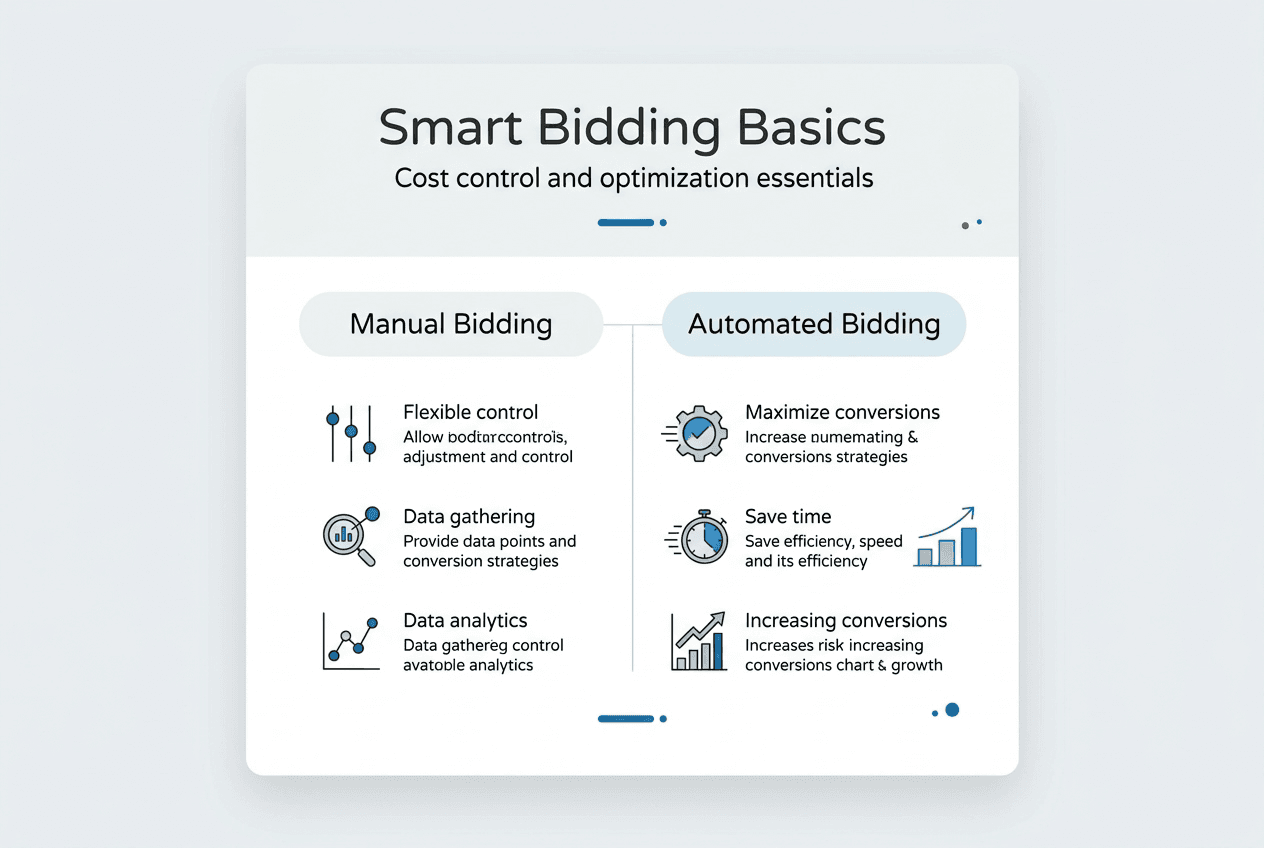 Manual CPC bidding lets you set maximum cost per click for each keyword, giving complete control over spend. You adjust bids based on performance, increasing for converting keywords and decreasing for expensive non-performers. This works well when starting campaigns because you’re learning what works without algorithms making decisions based on insufficient data. Manual bidding requires daily monitoring and adjustment but prevents automated systems from overspending during the learning phase.
Maximize Conversions bidding uses Google’s algorithms to automatically set bids that generate the most conversions within your budget. The system analyzes thousands of signals like device, location, time of day, and audience characteristics to predict conversion likelihood and adjust bids accordingly. This strategy scales efficiently once you have at least 30 conversions per month, but fails without adequate conversion data to train the algorithm.
Integration with conversion tracking and Google Analytics provides the data smart bidding needs. Accurate conversion tracking tells the algorithm which clicks led to business results. Google Analytics adds behavioral data like time on site and pages viewed, helping algorithms identify high-quality traffic patterns. Without this integration, automated bidding optimizes for the wrong outcomes.
Manual CPC bidding lets you set maximum cost per click for each keyword, giving complete control over spend. You adjust bids based on performance, increasing for converting keywords and decreasing for expensive non-performers. This works well when starting campaigns because you’re learning what works without algorithms making decisions based on insufficient data. Manual bidding requires daily monitoring and adjustment but prevents automated systems from overspending during the learning phase.
Maximize Conversions bidding uses Google’s algorithms to automatically set bids that generate the most conversions within your budget. The system analyzes thousands of signals like device, location, time of day, and audience characteristics to predict conversion likelihood and adjust bids accordingly. This strategy scales efficiently once you have at least 30 conversions per month, but fails without adequate conversion data to train the algorithm.
Integration with conversion tracking and Google Analytics provides the data smart bidding needs. Accurate conversion tracking tells the algorithm which clicks led to business results. Google Analytics adds behavioral data like time on site and pages viewed, helping algorithms identify high-quality traffic patterns. Without this integration, automated bidding optimizes for the wrong outcomes.
| Strategy | Control Level | Data Requirement | Best For | Performance |
|---|---|---|---|---|
| Manual CPC | Full control | None | New campaigns, learning phase | Good with active management |
| Maximize Conversions | Algorithm-driven | 30+ conversions/month | Established campaigns with data | Excellent when data-rich |
- Start all new campaigns with manual CPC bidding and conservative max CPC limits
- Monitor performance daily for the first two weeks, adjusting bids based on conversion data
- Once you accumulate 30 conversions, switch one campaign to Maximize Conversions as a test
- Compare performance between manual and automated campaigns for 30 days
- If automated outperforms manual by 15 percent or more, migrate remaining campaigns
- Continue monitoring automated campaigns weekly to catch budget overspend or performance drops
“Patience and data integration are crucial for smart bidding success. Rushing into automation without sufficient conversion data leads to wasted spend and poor results, while waiting too long to automate leaves performance gains on the table.”Professional PPC campaign management services time bidding transitions perfectly, maximizing control during data collection then leveraging automation for scale. They monitor algorithmic performance closely, ready to intervene when systems drift. Google Ads management services excel at bidding strategy because they understand both the art of manual optimization and the science of algorithmic efficiency.
Partner with Invisio Solutions for expert Google Ads management
Implementing these strategies requires expertise, time, and constant optimization that most SMB owners can’t sustain while running their businesses. Invisio Solutions specializes in Google Ads management services designed specifically for small and medium-sized businesses in the US and UK, combining local targeting precision with smart bidding efficiency and conversion-optimized landing pages. Our team handles everything from conversion tracking setup and keyword research to ad copy testing and bid management, ensuring your campaigns run at peak performance without consuming your time. We build customized strategies around your specific business goals, whether that’s generating more phone calls, filling your calendar with appointments, or driving online sales. Our PPC campaign management services and PPC optimization services have helped dozens of SMBs transform struggling campaigns into consistent lead generation engines. Contact Invisio Solutions today for a free consultation and discover how professional Google Ads management can grow your business.
“Invisio Solutions transformed our Google Ads ROI from break-even to 400 percent in just three months through expert tracking setup, laser-focused local targeting, and relentless optimization that we could never achieve in-house.”


