
What are paid ads? A beginner’s guide for businesses

Many business owners hear “paid ads” and immediately think of complex dashboards, wasted budgets, and confusing jargon. The reality is simpler. Paid ads are targeted online ads charged per click or impression, designed to put your business in front of potential customers exactly when they’re searching. This guide breaks down what paid ads are, how they work, and practical strategies to make them deliver results without burning through your marketing budget.
Table of Contents
- Key takeaways
- Understanding paid ads: what they are and how they work
- Types of paid ads and their marketing purposes
- How to optimize your paid ad campaigns for success
- Challenges and advanced insights in paid advertising
- Explore expert PPC and digital marketing services
- FAQ
Key Takeaways
| Point | Details |
|---|---|
| Auction mechanics | Paid ads operate in real time auctions where ad rank depends on bid amount, relevance, and quality score. |
| Quality score impact | Quality scores range from 1 to 10, and higher scores reduce cost per click and improve placement. |
| Match types and negatives | Match types determine how closely queries align with keywords and negative keywords prevent irrelevant searches. |
| Platform variety and goals | Platforms extend beyond search to social, display, and video with distinct targeting options to meet different marketing objectives. |
| Ad relevance and landing pages | Focus relentlessly on ad relevance and landing page experience to improve quality score and lower costs. |
Understanding paid ads: what they are and how they work
Paid ads operate on a simple principle: you pay to place your message in front of people actively looking for what you offer. Core mechanics involve real-time auctions where ad rank depends on bid amount, relevance, and quality score. Every time someone searches a keyword you’re targeting, platforms like Google run an instant auction to determine which ads appear and in what order.
Your ad rank determines placement. It’s calculated by multiplying your maximum bid by your quality score, a metric measuring expected click-through rate, ad relevance, and landing page experience. Quality scores range from 1 to 10, with scores above 7 considered strong. Higher quality scores reduce your cost per click and improve ad position, meaning you can outrank competitors who bid more but deliver less relevant experiences.
Match types control how closely search queries must align with your keywords. Exact match shows ads only for precise keyword searches, phrase match requires the keyword phrase in order, and broad match triggers ads for related variations. Broad match without careful management generates irrelevant clicks and drains budgets fast.
Negative keywords prevent your ads from showing for irrelevant searches. If you sell premium software, adding “free” as a negative keyword stops your ads from appearing when users search “free software,” saving budget for qualified prospects. Building a robust negative keyword list is ongoing work that directly impacts campaign efficiency.
Platforms extend beyond search engines. Social media networks like Facebook and LinkedIn, display networks showing banner ads across websites, and video platforms like YouTube all operate on similar auction principles with platform-specific targeting options. Each platform offers unique audience data, from search intent on Google to demographic and interest targeting on social channels.
Pro Tip: Focus relentlessly on ad relevance and landing page experience to improve quality score organically. Better scores reduce costs and improve placement without increasing bids. Start by ensuring your landing pages match ad messaging exactly, then refine based on user behavior data. Professional PPC optimization services can accelerate this process significantly.
Types of paid ads and their marketing purposes
Different ad types serve distinct marketing goals. Understanding which format aligns with your objectives prevents wasted spend and maximizes impact.
Paid search ads appear on search engine results pages when users enter relevant queries. Paid search targets high buyer intent, capturing demand from people actively looking for solutions. These ads work best for bottom-funnel conversions where prospects know what they need and are comparing options.

Paid social ads run on platforms like Facebook, Instagram, LinkedIn, and TikTok. Paid social typically shows lower click-through rates but builds top-funnel awareness by reaching users based on demographics, interests, and behaviors rather than active search intent. Social ads create demand and introduce your brand to audiences who may not know they need your solution yet.
Display and programmatic ads place visual banners across websites within ad networks. These ads prioritize broad awareness and retargeting, keeping your brand visible as prospects browse content related to their interests. Programmatic advertising uses automated bidding across multiple ad exchanges to optimize placements in real time.
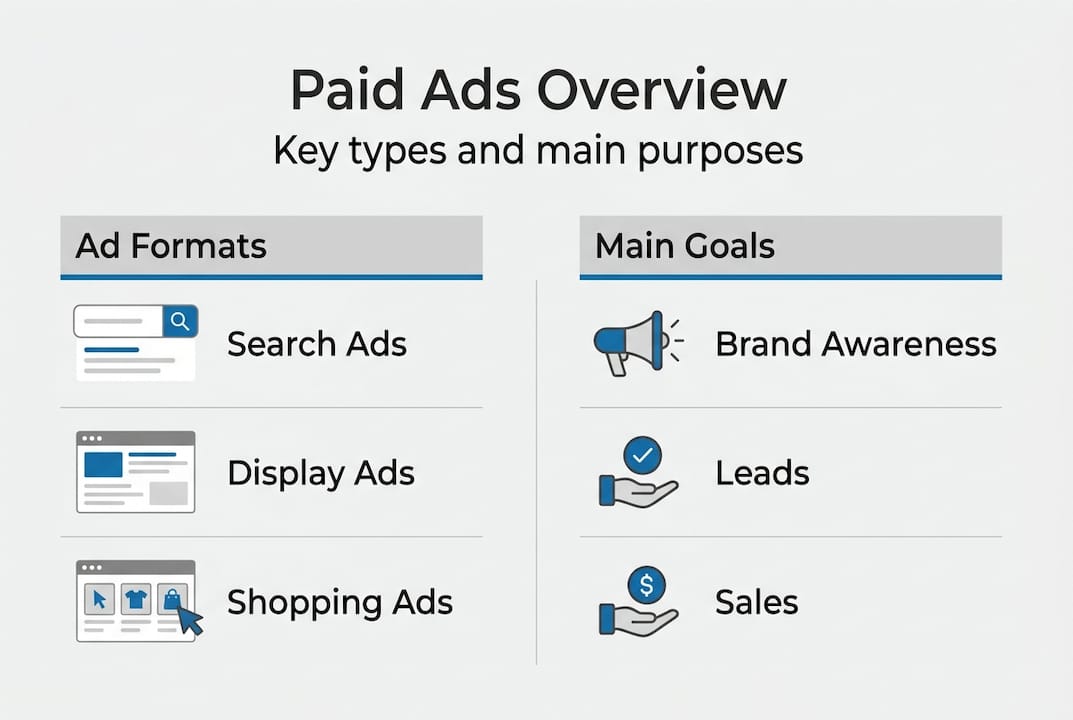
Shopping ads showcase product images, prices, and merchant information directly in search results. Ecommerce businesses use shopping ads to capture high-intent buyers ready to purchase, displaying inventory exactly when prospects search for specific products. These ads require product feed integration but deliver strong conversion rates for online retailers.
Remarketing targets previous website visitors with tailored ads as they browse other sites or social platforms. This approach increases conversion rates by re-engaging warm prospects who showed initial interest but didn’t complete desired actions. Remarketing works across search, display, and social channels.
Performance Max campaigns use Google’s AI to run ads across Search, Display, YouTube, Gmail, and Discover simultaneously. The algorithm optimizes bids, placements, and creative combinations based on conversion goals, reducing manual management while expanding reach. Performance Max suits advertisers comfortable surrendering creative control for automated efficiency.
| Ad Type | Primary Goal | Best For | Typical CTR |
|---|---|---|---|
| Paid search | Demand capture | Bottom-funnel conversions | 3-5% |
| Paid social | Demand creation | Top-funnel awareness | 0.5-1.5% |
| Display/programmatic | Brand awareness | Broad reach and retargeting | 0.1-0.5% |
| Shopping ads | Product sales | Ecommerce transactions | 0.8-1.2% |
| Remarketing | Conversion boost | Re-engaging warm leads | 0.7-1% |
| Performance Max | Cross-channel automation | Hands-off optimization | Varies |
Choosing the right ad type starts with identifying where your audience is in their buying journey. PPC marketing services can help map ad types to customer journey stages, while specialized ecommerce PPC strategies optimize shopping and remarketing campaigns for online stores.
How to optimize your paid ad campaigns for success
Running profitable campaigns requires structured testing and continuous refinement. Follow these core optimization practices to maximize return on ad spend.
- Structure campaigns with themed ad groups. Group tightly related keywords into focused ad groups with tailored ad copy. A campaign selling running shoes should have separate ad groups for “trail running shoes,” “road running shoes,” and “minimalist running shoes” rather than lumping all variations together. Tight theme alignment improves relevance scores and click-through rates.
- Choose appropriate bid strategies. Manual bidding gives complete control over keyword-level bids, ideal when you have conversion data and want precise budget allocation. Smart automated bidding strategies like Target CPA or Target ROAS let algorithms adjust bids based on conversion likelihood, effective once campaigns accumulate sufficient conversion data. Start manual, then test automation as data builds.
- Optimize creative elements continuously. Ad copy should speak directly to search intent with clear value propositions and compelling calls to action. Test headlines emphasizing different benefits, vary description lines, and align messaging with landing page content. Visual ads require testing images, videos, and design elements to identify what resonates with your audience.
- Run systematic A/B tests. Compare ad versions by changing one element at a time: headline variations, different calls to action, or alternate landing pages. Let tests run until statistical significance emerges, typically requiring at least 100 clicks per variation. Testing reveals what messaging and creative approaches drive the highest conversion rates.
- Ensure landing pages match ad promises. If your ad promotes “free shipping on orders over $50,” that offer must be immediately visible on the landing page. Mismatched messaging increases bounce rates and tanks quality scores. Landing page experience directly impacts both ad rank and conversion rates.
- Monitor and adjust based on performance data. Continuous optimization beats set-and-forget approaches every time. Review search term reports weekly to identify new negative keywords, pause underperforming ads, increase bids on high-converting keywords, and reallocate budget to top-performing campaigns. Paid advertising rewards active management.
Pro Tip: Build negative keyword lists from day one and expand them weekly. Review search term reports to catch irrelevant queries triggering your ads, then add those terms as negatives immediately. This single practice prevents more wasted spend than any other optimization tactic. Professional PPC campaign management services handle this ongoing work systematically, and experienced PPC specialists know exactly which metrics signal needed adjustments.
Challenges and advanced insights in paid advertising
Even well-optimized campaigns face obstacles that drain budgets and reduce effectiveness. Understanding these challenges helps you anticipate and mitigate them.
- Click fraud wastes ad spend. Competitors or bots clicking your ads artificially inflate costs without generating real prospects. IP exclusions and fraud detection tools help identify and block suspicious activity. Monitor for unusual click patterns from specific locations or times of day.
- Ad fatigue reduces social campaign performance. When the same creative runs too long on social platforms, audience response drops as users become blind to repeated messaging. Refresh ad creative every 2-4 weeks and rotate new images, videos, and copy to maintain engagement.
- Broad match keywords without negatives drive irrelevant traffic. Broad match offers reach but triggers ads for loosely related searches. Without aggressive negative keyword management, you’ll pay for clicks from users with zero purchase intent. Balance broad match reach with phrase and exact match precision.
- Algorithm changes shift campaign performance unexpectedly. Platform updates to auction mechanics, quality score calculations, or automated bidding systems can suddenly impact results. Stay informed about platform announcements and be ready to adjust strategies when major updates roll out.
- Attribution complexity obscures true ROI. Platform-reported conversions often overstate impact because they use last-click attribution models. Paid ads combine immediate visibility with long-term brand effects that standard attribution misses. Experts recommend measuring incremental return on ad spend through marketing mix modeling to understand true lift beyond what would have happened organically.
- Channel selection impacts funnel stage effectiveness. Paid search excels at bottom-funnel efficiency where prospects have clear intent, while paid social drives top-funnel awareness and consideration. Mixing channels without understanding their strengths leads to misaligned expectations and poor budget allocation.
“Average PPC ROI can be $2 for every $1 spent when optimized, but attribution and long-term brand impact must be considered beyond platform-reported metrics.”
Successful advertisers acknowledge these complexities and build campaigns accounting for fraud risks, creative fatigue, and attribution limitations. They test continuously, monitor vigilantly, and adjust strategies as platforms and audience behaviors evolve. Professional PPC ads services bring expertise in navigating these challenges, while full-service PPC agencies provide comprehensive management across all paid channels.
Explore expert PPC and digital marketing services
Understanding paid ads is one thing. Running profitable campaigns that consistently deliver qualified leads and sales is another. If you’re ready to move beyond theory and start generating real results, professional support accelerates your success dramatically.
Invisio Solutions specializes in PPC campaign management and optimization designed to maximize your return on ad spend while eliminating wasted budget. Our team handles campaign structure, bid strategy, creative testing, negative keyword management, and ongoing analytics so you can focus on closing deals instead of wrestling with ad platforms. We’ve helped businesses across industries reduce cost per acquisition while scaling lead volume through data-driven paid advertising strategies. Whether you need comprehensive campaign management, focused optimization services, or strategic guidance to drive qualified leads, we build custom solutions that align with your specific business goals and growth targets.
FAQ
What are the different payment models in paid ads?
Paid ads commonly use pay-per-click (PPC), pay-per-impression (CPM), and pay-per-action (CPA) models. PPC charges only when someone clicks your ad, making it ideal for driving traffic. CPM charges per thousand impressions, suited for awareness campaigns. CPA charges when users complete specific actions like purchases or form submissions, aligning costs directly with conversions.
How do quality score and ad relevance impact my campaign?
Quality score measures ad relevance, expected click-through rate, and landing page experience on a 1-10 scale. Higher quality scores reduce cost per click and improve ad placement, letting you outrank competitors who bid more but deliver less relevant experiences. Improving quality score from 5 to 8 can cut costs by 30% or more while boosting visibility.
What are common challenges when running paid ads?
Click fraud, ad fatigue, broad match keyword misuse, and unexpected algorithm changes can significantly reduce campaign effectiveness and waste budget. Regular optimization, systematic negative keyword expansion, creative refreshes, and performance monitoring help mitigate these challenges. Professional management catches issues faster and implements fixes before they drain significant budget.
Can I run paid ads without prior digital marketing experience?
Beginners can absolutely run paid ads, but understanding fundamentals like keyword match types, quality score, and bid strategies dramatically improves results and prevents costly mistakes. Starting with small budgets and focused campaigns lets you learn while minimizing risk. Professional campaign management services accelerate success by applying proven strategies from day one, often delivering better ROI than trial-and-error learning while you build internal expertise.
Recommended