
Effective branding for small businesses: build trust and stand out

TL;DR:
- Strong small business branding focuses on consistency, authenticity, and customer experience across channels.
- Building blocks include a clear narrative, visual identity, style guide, asset library, and incremental testing.
- AI tools enhance branding efficiency but require human oversight to maintain genuine, on-brand messaging.
Branding is not a luxury reserved for corporations with massive budgets. For small businesses, a clear and consistent brand can be the single biggest factor separating you from a forgettable competitor. Authenticity over aesthetics is what drives real customer loyalty, and today’s digital tools make it easier than ever to build something genuinely compelling. In this article, you’ll learn what branding really means for smaller ventures, the core building blocks every brand needs, how to choose the right approach for your budget, and how AI tools are changing the game in 2026.
Table of Contents
- What is branding for small business?
- Building blocks of a resilient small business brand
- DIY or professional? Branding strategies that fit your budget
- Leveraging digital and AI tools in small business branding
- Why authentic storytelling, not perfection, powers small business brands
- Take your brand further with expert support
- Frequently asked questions
Key Takeaways
| Point | Details |
|---|---|
| Branding is strategic | A successful small business brand reflects your values, promises, and personality across every digital channel. |
| Update without risk | Small tweaks and consistent storytelling outperform risky, drastic rebrands for most small businesses. |
| Embrace AI with care | AI and digital tools bring speed and efficiency, but human oversight keeps your brand authentic. |
| DIY plus pro wins | A blend of do-it-yourself planning and professional design maximizes branding results on a budget. |
What is branding for small business?
Understanding how essential branding truly is for smaller ventures, let’s clarify what branding actually means for your business.
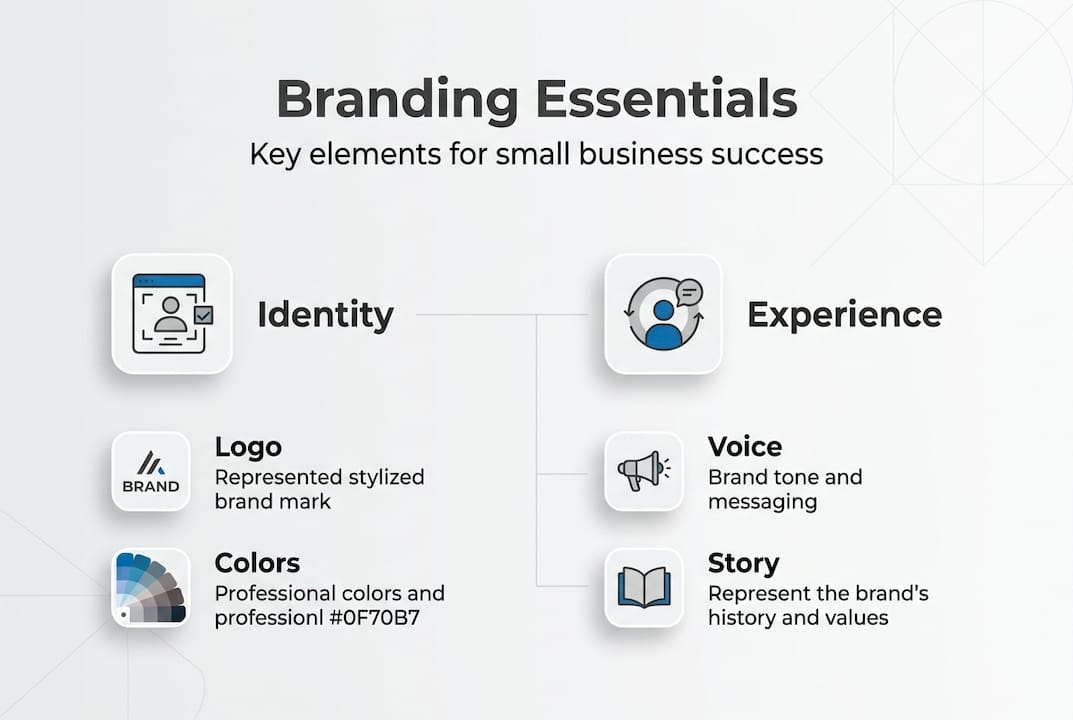
Many owners think branding starts and ends with a logo. It does not. Your brand is the total experience a customer has every time they interact with your business, from your website copy and social media tone to how your team handles a complaint. It is your promise, your values, and the consistent feeling you create across every touchpoint.
Digital platforms have made this more complex and more powerful at the same time. Your brand now lives on Instagram, Google Search, email campaigns, and review sites simultaneously. Inconsistency across those channels creates confusion. Consistency builds recognition and trust.
The core elements of a strong small business brand include:
- Tone of voice: How you communicate, whether formal, conversational, or somewhere in between, should stay consistent across every channel.
- Visual identity: Your logo, color palette, typography, and imagery all work together to signal who you are instantly.
- Messaging: The words you use to describe your value, your audience, and your difference should be clear and repeatable.
- Customer experience: Every interaction, from a first website visit to post-sale follow-up, shapes how people feel about your brand.
- Employee advocacy: Your team members are brand ambassadors. Their stories and voices add a human layer no ad campaign can replicate.
“The brands that win are not always the most polished. They are the most consistent, the most human, and the most honest about who they are and who they serve.”
AI tools can help you produce visuals and personalize content faster, but as branding experts note, human oversight is non-negotiable. Generic AI outputs without a clear brand voice can actually dilute your identity rather than strengthen it. If you want to see what purposeful branding and identity design looks like in practice, it starts with these foundational decisions made intentionally.
Storytelling is the bridge between your values and your audience. Sharing real customer stories, your founding journey, or even honest lessons from setbacks creates an emotional connection that polished graphics alone cannot build.
Building blocks of a resilient small business brand
Now that we’ve covered what branding means for small businesses, let’s break down the essential elements every brand needs to thrive.
A resilient brand does not happen by accident. It is built methodically, with each element reinforcing the next. Here are the core building blocks you need to get right:
- Brand narrative: Define why your business exists beyond making money. What problem do you solve? Who do you serve? A purpose-driven story gives customers a reason to choose you and stay loyal.
- Logo, colors, and typography: These visual pillars communicate your brand before a single word is read. Choose colors that reflect your brand’s personality and stick with them. Consistency here builds instant recognition.
- Style guide: Document your visual and verbal rules in one place. Include logo usage, color codes, font choices, and tone-of-voice guidelines. Even a simple two-page guide prevents costly inconsistencies as your team grows.
- Asset library: Organize all your brand files, templates, and approved imagery in a shared folder. This saves time and keeps every piece of content on-brand, whether it is created by you, a freelancer, or an agency.
- Incremental testing: Before you consider any brand update, test small changes first. Swap a color in your email templates or update your tagline on one platform and measure the response before rolling it out everywhere.
A critical stat worth knowing: 40% of hasty rebrands fail, often because they abandon brand equity that took years to build. Style guides and asset libraries are not just organizational tools. They are your defense against drift and inconsistency as your business scales.
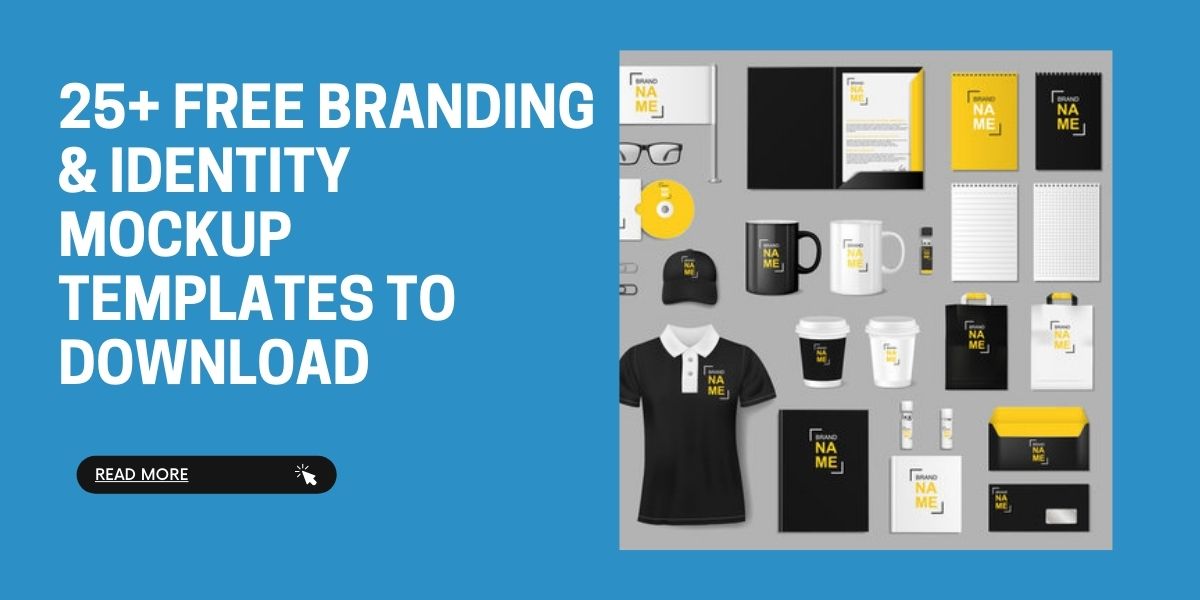
If you are starting out or refreshing your brand on a tight budget, free branding templates can give you a professional foundation without the agency price tag. Pairing those with the right marketing tools for small business helps you stay consistent across channels from day one.

Pro Tip: Avoid radical rebrands. Instead, test small resets, such as updating your brand colors slightly or refining your tagline, before committing to a full overhaul. This approach preserves the recognition you have already earned while keeping your brand feeling fresh.
DIY or professional? Branding strategies that fit your budget
Once you’ve mapped out your core brand essentials, the next decision is whether to do it yourself or invest in professional support.
There is no single right answer here. The best approach depends on your stage, budget, and goals. Here is a practical comparison:
| Approach | Best for | Pros | Cons |
|---|---|---|---|
| DIY | Early-stage startups | Low cost, full control | Time-intensive, risk of inconsistency |
| Hybrid | Growing businesses | Cost-effective, pro quality on key assets | Requires clear direction from you |
| Full agency | Established businesses pivoting or scaling | Expert strategy, cohesive execution | Higher investment, longer timelines |
For most small businesses, the hybrid model wins. You handle strategy and day-to-day content, while a professional handles the assets that matter most: your logo, website design, and brand guidelines. This approach delivers strong ROI without overextending your budget.
When is a full rebrand actually worth it? Only when your current brand is actively harming your growth, such as when you are entering a new market, targeting a completely different audience, or recovering from a reputation issue. Otherwise, incremental refreshes outperform costly overhauls for small and medium businesses almost every time.
Key checklist for choosing your approach:
- Do you have a clear brand strategy already? If not, start there before spending on design.
- Is your current brand recognizable to your audience? If yes, refresh rather than replace.
- What is your timeline? Full rebrands take months. Refreshes can happen in weeks.
- Do you have internal design skills? If not, outsource at least your logo and core visual assets.
For budget-conscious owners, exploring top AI tools for marketing can stretch your resources further, especially for content creation and social media visuals.
Leveraging digital and AI tools in small business branding
A smart branding approach today uses more than creativity. Digital and AI-driven tools can multiply your results if you know where and how to use them.
AI has moved from novelty to practical necessity for small business branding. Tools now exist to generate on-brand visuals, write consistent copy, personalize email campaigns, and even suggest color palettes based on your brand values. The speed advantage is real: AI productivity tools are saving small businesses 15 to 25 hours weekly on content and design tasks.
But speed without strategy creates noise. As branding research confirms, AI is most effective when paired with human oversight to ensure outputs stay authentic and on-brand. A tool that generates 20 social posts in minutes is only valuable if those posts actually sound like your business.
Here is a practical breakdown of tools by function:
| Tool type | Function | Budget level | Best use case |
|---|---|---|---|
| Canva / Adobe Express | Visual design | Free to low | Social graphics, brand templates |
| ChatGPT / Claude | Copy and messaging | Free to low | Captions, email drafts, brand voice testing |
| Midjourney / DALL-E | AI image generation | Low to mid | Custom brand imagery, concept visuals |
| Looka / Brandmark | Logo creation | Low | Starting logo design on a budget |
| Mailchimp / Klaviyo | Email personalization | Free to mid | Branded email campaigns |
Quick wins small businesses are seeing with AI in 2026:
- Batch-creating a month of branded social content in a single afternoon
- Using AI to generate multiple tagline options, then testing them with real customers
- Personalizing landing page copy based on traffic source, without writing each version manually
- Generating brand mood boards to align team members before a design project begins
For a deeper look at how AI for marketing is reshaping what small businesses can achieve, the practical applications go well beyond content creation.
Pro Tip: Batch-create your branded content in one focused session using AI tools, then spend 20 minutes reviewing each piece for authenticity. Does it sound like your brand? Does it reflect your values? Edit anything that feels generic before it goes live.
Why authentic storytelling, not perfection, powers small business brands
The technical tools are genuinely game-changing. But in our experience working with small businesses across industries, the brands that grow fastest are rarely the ones with the most polished visuals. They are the ones with the most honest stories.
Most small business branding mistakes happen when owners chase trends instead of sharing what actually makes their business worth choosing. A perfectly designed logo means nothing if the messaging behind it is vague. A slick website loses its impact if the copy reads like it could belong to any business in your category.
Authenticity over aesthetics is not just a feel-good principle. It is a measurable competitive advantage. Customers are more likely to trust a brand that shares real employee stories, honest customer journeys, and even the occasional setback than one that only projects perfection.
AI and digital tools are powerful amplifiers, but they amplify what you give them. Feed them a genuine, specific brand story and they produce compelling content. Feed them generic inputs and you get generic outputs.
Our view is this: subtle, consistent improvements to your brand, grounded in real stories and clear values, will outperform a flashy launch almost every time. If you want to see what branding built on genuine identity looks like, start with your story, not your style guide.
Take your brand further with expert support
Ready to apply what you’ve learned or see examples in action? Here’s how to take the next step with expert support.
At Invisio Solutions, we work with small businesses and entrepreneurs to build brands that are clear, consistent, and built to grow. From strategy and branding consultancy to full digital execution, our team brings the expertise to make your brand work harder across every channel. Want to see what results look like in practice? Explore our branding case study to see how we have helped real businesses build standout identities. Reach out today to start a conversation about where your brand is headed.
Frequently asked questions
What is the first step in branding for small businesses?
Start by clearly defining your business values, mission, and what makes you unique. Your brand promise and values are the foundation every visual and messaging decision should build on.
How much should a small business budget for branding?
Budgets vary widely, but most successful small businesses combine DIY strategies with targeted professional design for the best ROI. A hybrid approach keeps costs manageable while ensuring your most visible assets look polished and professional.
How can AI help with small business branding?
AI tools can automate design, streamline content production, and help personalize campaigns at scale. However, human oversight ensures authenticity and keeps outputs aligned with your actual brand voice.
Is it better to rebrand or refresh an existing brand?
For most small businesses, incremental brand refreshes are lower risk and deliver better results than full rebrands. 40% of hasty rebrands fail, making a measured refresh the smarter choice in most situations.
Recommended
- Branding And Identity Design Services | Build A Standout Brand
- Custom Logo Design Services | Professional Brand Identity Solutions
- Mastering SEO For Small Businesses: Guide To Online Growth
- Best Logo Designers Professionals For Your Brand Identity
- Networking Best Practices for 2025 Success | Re-Solution