
What is branding? Principles, strategies & real impact

Most business owners know branding matters, yet many still treat it as nothing more than a logo and a color scheme. That’s a costly assumption. Consistent branding can increase revenue by 10 to 20 percent, yet the majority of small businesses invest in visuals without ever defining the deeper identity behind them. Branding is the strategic process of shaping how your business is perceived, trusted, and remembered. Get it right, and it drives loyalty, premium pricing, and long-term growth. This article breaks down what branding really means, how it works, and exactly how you can apply it to your business.
Table of Contents
- Defining branding: What it really means
- The business impact of branding
- The mechanics of building a brand
- Understanding brand architecture
- Branding mistakes and how to avoid them
- Applying branding to your business: Next steps
- Elevate your brand with expert support
- Frequently asked questions
Key Takeaways
| Point | Details |
|---|---|
| Branding shapes perception | Branding defines how customers see and connect with your business across all touchpoints. |
| Consistent branding drives results | Keeping your brand consistent can lift revenue and visibility significantly. |
| Effective branding is strategic | A strong brand is built on clear goals, audience insight, and tested creative elements. |
| Brand architecture boosts clarity | Organizing your brand portfolio the right way strengthens recognition and reach. |
| Test and refine continuously | Regularly review branding decisions using real customer feedback to avoid costly errors. |
Defining branding: What it really means
Branding is one of the most misused words in business. Many people confuse it with marketing, but the two are distinct. Marketing is what you do to attract customers. Branding is what you are to those customers once they find you.
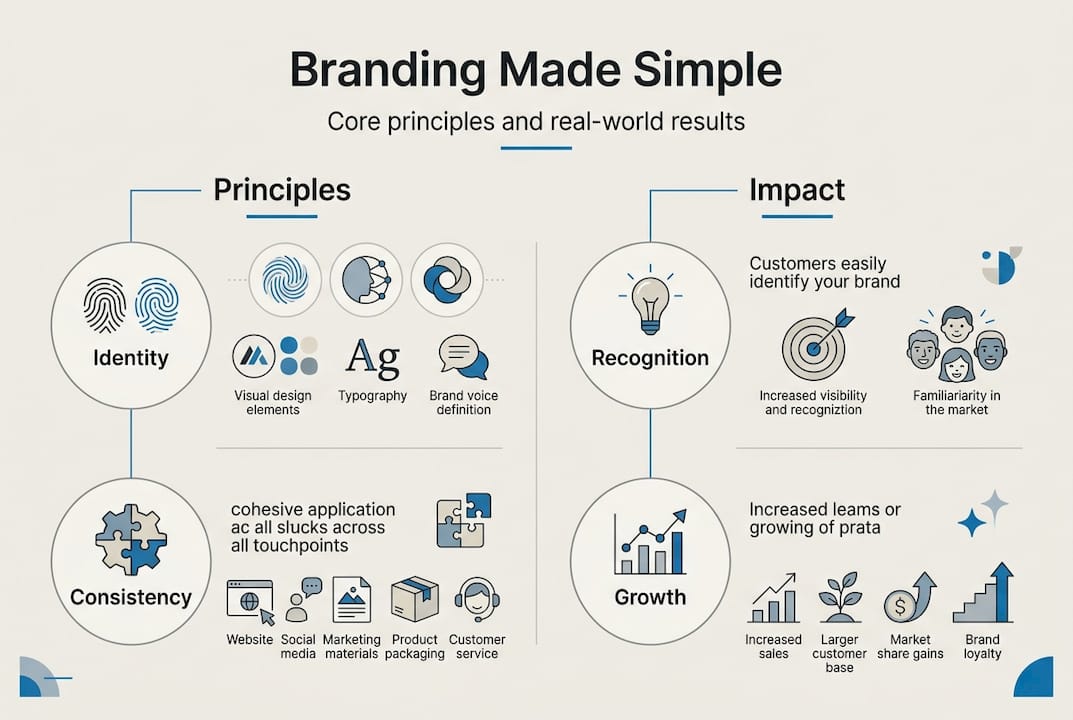
Branding is the process of creating a unique identity through distinct elements like name, logo, colors, tagline, packaging, tone, and imagery that shape customer perceptions and emotional connections. It’s not a campaign. It’s the foundation every campaign is built on.
Think about how you feel when you see certain brands. You don’t analyze them. You react to them. That gut-level response is branding at work. As Harvard Business School explains, brand identity acts like tinted glasses that color how consumers understand, experience, and value a product or service.
The core elements that make up a brand include:
- Name: The first impression and the anchor of recognition
- Logo: The visual symbol that represents your business at a glance
- Color palette: Colors that trigger specific emotions and associations
- Tagline: A short phrase that communicates your core promise
- Tone and voice: How your brand speaks across every channel
- Imagery: The visual style that reinforces your brand personality
- Packaging: The physical or digital presentation of your product
Our branding and identity design work starts with these foundational elements because without them, every other marketing effort lacks direction.
The business impact of branding
Knowing what branding is, it’s important to see how these concepts translate into real business results. The numbers are hard to ignore.
Consistent branding increases revenue by 10 to 20 percent. Gucci’s brand identity refresh led to an 86% increase in quarterly online sales. And organizations with clear brand architecture achieve 3.5 times more visibility than those without. These aren’t abstract benefits. They’re measurable outcomes tied directly to brand decisions.

| Company | Brand action | Result |
|---|---|---|
| Gucci | Identity refresh and repositioning | 86% increase in quarterly online sales |
| Apple | Consistent minimalist brand system | Premium pricing power and global loyalty |
| Airbnb | Rebrand focused on belonging | Massive increase in brand recognition and trust |
| Small businesses | Consistent visual and verbal identity | 10 to 20% revenue increase on average |
Branding also supports market share and customer loyalty in ways that advertising alone cannot. When customers recognize and trust your brand, they return. They refer others. They pay more. That’s the compounding ROI of strong branding.
Stat to know: Organizations with clear brand architecture achieve 3.5 times more visibility than competitors without defined brand structures.
Our branding services for growth are built around these outcomes, and you can see real results in our client case studies.
The mechanics of building a brand
With brand impact proven, here are the practical steps to actually building and managing a powerful brand. Branding mechanics involve defining purpose, audience, value proposition, and consistent elements across touchpoints to build emotional connections and differentiation.
Here’s a proven framework to follow:
- Define your purpose and values. Why does your business exist beyond making money? What do you stand for? This is your brand’s north star.
- Know your audience deeply. Build detailed profiles of your ideal customers. Understand their goals, frustrations, and what they value in a brand.
- Clarify your unique position. What makes you different from competitors? Your brand must own a specific space in the customer’s mind.
- Develop your visual identity. Logo, colors, typography, and imagery should all reflect your brand personality. Our custom logo design process ensures every visual element is intentional.
- Define your verbal identity. Tone, voice, tagline, and messaging guidelines keep communication consistent across every channel.
- Apply consistently across all touchpoints. Website, social media, packaging, email, and ads must all feel like the same brand. Our UI/UX design for branding ensures your digital presence matches your brand identity.
- Review and iterate. Branding is not a one-time project. Revisit it regularly as your business and market evolve.
As Forbes notes, for entrepreneurs, branding is a scalable story beyond the logo, and poor branding is a costly long-term mistake. Start with free branding templates to visualize your identity before committing to a full build.
Pro Tip: Never finalize brand decisions based solely on internal team feedback. Test your brand elements with real customers or target audience members. Internal bias is one of the most common reasons branding misses the mark.
Understanding brand architecture
Once you grasp the basics, it’s also key to organize your brands or products in a way that maximizes clarity and reach. Brand architecture is the system that defines how your brands, products, or services relate to each other. It’s the structure behind the portfolio.
Brand architecture strategies include four main models:
| Architecture type | Description | Best for |
|---|---|---|
| Branded House | One master brand covers all products | Businesses with a strong core identity (e.g., Apple) |
| House of Brands | Each product has its own brand | Diverse portfolios targeting different audiences (e.g., Procter & Gamble) |
| Endorsed Branding | Sub-brands carry parent brand endorsement | Businesses expanding into new markets |
| Sub-branding | Parent brand launches distinct but related sub-brands | Companies adding premium or niche product lines |
Choosing the right structure depends on your growth goals, audience diversity, and how much brand equity you’ve already built. A startup with one core product benefits from a Branded House approach. A growing company with multiple distinct offerings may need a House of Brands or Sub-brand model.
The payoff is real. Clear brand architecture delivers 3.5 times more visibility than disorganized brand structures. Our brand architecture planning services help you map the right structure for your specific business stage.
Branding mistakes and how to avoid them
While great branding delivers value, even top companies can stumble without the right approach. The most dangerous mistakes often come from within.
Research shows that marketers often overestimate fame and underestimate the uniqueness of brand elements compared to what consumer data actually shows. In other words, your team may love your brand far more than your customers do. That gap is expensive.
Tropicana’s 2009 packaging redesign is a classic example. The company replaced its iconic orange-with-straw image with a generic design. Sales dropped 20% in just six weeks, costing an estimated $30 million. The internal team loved it. Customers didn’t recognize it.
The most expensive branding mistakes to avoid:
- Inconsistency across channels: Different logos, colors, or tones on different platforms erode trust fast
- Skipping audience research: Building a brand around internal preferences instead of customer insights
- Neglecting emotional appeal: Focusing only on features and ignoring how the brand makes people feel
- Treating branding as a one-time task: Brands that don’t evolve become irrelevant
- Overinvesting in logo, underinvesting in story: A beautiful logo with no clear brand narrative won’t build loyalty
- Copying competitors: Mimicking successful brands creates confusion, not differentiation
Pro Tip: Use customer surveys, social listening tools, and A/B testing to validate brand decisions with real data. Your instincts are a starting point, not a final answer. Working with a proven best logo design agency ensures your visual identity is grounded in strategy, not guesswork.
Applying branding to your business: Next steps
Armed with knowledge of best practices and pitfalls, here’s how you can put branding to work for your own business. Branding is not reserved for Fortune 500 companies. It’s one of the highest-ROI investments any business can make, regardless of size.
93% of executives agree that long-term brand building is essential for growth, and 91% link it directly to sustained commercial success. That’s near-universal consensus from the top.
Here’s your action checklist:
- Audit your current branding. Review every customer touchpoint. Is the visual and verbal identity consistent? Does it reflect who you are today?
- Set clear brand goals. Define what you want your brand to achieve. More recognition? Higher trust? Premium positioning?
- Involve your customers. Gather feedback through surveys, reviews, and direct conversations. Let real data guide your decisions.
- Prioritize your brand story. Define your purpose, values, and the narrative that connects your business to your audience emotionally.
- Build or refresh your visual identity. Use our free branding mockup templates to explore options before committing to a full redesign.
- Invest consistently over time. Branding compounds. The businesses that commit to it long-term are the ones that build lasting market presence.
Our branding services are designed to support businesses at every stage, whether you’re starting from scratch or refreshing an existing identity.
Elevate your brand with expert support
If you’re ready for a deeper transformation, professional expertise can make all the difference. Building a brand that resonates, converts, and grows requires more than good design. It requires strategy, consistency, and execution across every channel.
At Invisio Solutions, we offer end-to-end branding and identity design services that cover everything from brand strategy and custom logo design to digital marketing and website development. We work with businesses that are serious about building a brand that stands out and delivers measurable results. Whether you need a full brand build or a targeted refresh, our team is ready to help you create something that lasts. Reach out today and let’s build a brand your customers will remember.
Frequently asked questions
What are the essential elements of branding?
The essential branding elements are name, logo, color palette, tagline, packaging, tone and voice, and imagery. Each element works together to shape how customers perceive and value your business.
How does branding affect customer trust?
Consistent branding creates clear, predictable perceptions that build confidence over time. As research confirms, brand identity colors how consumers understand and value a product, which directly strengthens trust.
Can small businesses benefit from branding?
Absolutely. Even small businesses can see measurable gains from effective branding. Consistent branding increases revenue by 10 to 20 percent, making it one of the highest-ROI investments available to businesses of any size.
What is branding architecture, and why does it matter?
Brand architecture is the system that organizes how your brands or products relate to each other. Organizations with clear brand architecture achieve 3.5 times more visibility, making it a critical strategic decision for growing businesses.
What’s a common branding mistake businesses should avoid?
One of the most frequent mistakes is assuming your internal brand perceptions match what customers actually think. Research shows marketers overestimate brand familiarity and uniqueness compared to real consumer data, leading to costly missteps.
Recommended
- Branding And Identity Design Services | Build A Standout Brand
- Graphic Design Services | Your Brand With Invisio Solutions
- Discover The Best Logo Design Agency For Memorable Branding
- 25+ Free Branding, Mockup Templates Available For Instant Download Today
- Death of Generic Digital Experiences: Why Unique Design Matters