

Mobile app vs website: choose the right platform

Choosing between a mobile app and a website is one of the most consequential digital decisions your business will make, yet most owners approach it with incomplete information. Some assume apps are the premium option. Others believe a website alone is enough. The reality is that the wrong choice can drain your budget, limit your reach, and stall your growth before you gain momentum. This article breaks down the real differences, side-by-side costs, user behavior data, and the specific criteria that should drive your decision, so you can invest with confidence rather than guesswork.
Table of Contents
- Understanding the roles of mobile apps and websites
- Comparing features, functionality, and user experience
- Cost, development, and maintenance considerations
- Factors to consider when making your decision
- How businesses apply mobile and web strategies in the real world
- Why the best choice is rarely either/or
- See what’s possible with the right digital partner
- Frequently asked questions
Key Takeaways
| Point | Details |
|---|---|
| Apps increase engagement | Mobile apps are best for high-engagement, loyalty, and feature-rich experiences. |
| Websites offer broad access | Websites are easier to find via search and work well for most new or small businesses. |
| Weigh long-term costs | App development and maintenance can be far more expensive than websites. |
| Hybrid strategies work | Many businesses succeed by starting with a strong website then layering on an app over time. |
Understanding the roles of mobile apps and websites
Before comparing the two, it helps to understand what each platform actually is and what it is built to do.
A mobile app is a software application installed directly on a user’s device. Apps come in three main forms: native apps (built specifically for iOS or Android), hybrid apps (built with web technologies but packaged as an app), and Progressive Web Apps or PWAs (web-based apps that behave like native apps). Each has different performance levels, development costs, and capabilities.
A website is accessed through a browser and does not require installation. Modern websites are built to be responsive (adapting to any screen size) or adaptive (serving different layouts to different devices). They are universally accessible and easy to find through search engines.
Here is where each platform typically excels:
- Mobile apps: Loyalty programs, push notifications, offline functionality, personalized dashboards, gaming, and on-demand services
- Websites: Brand discovery, content marketing, e-commerce for new customers, local service listings, and SEO-driven traffic
- E-commerce brands often use both: a website to attract new visitors and an app to retain existing customers
- Local service businesses (plumbers, consultants, clinics) typically get stronger ROI from a well-optimized website
- Content-focused businesses (media, blogs, news) rely heavily on web traffic from search engines
Smartphone users spend 88% of their mobile time in apps versus just 12% in web browsers, according to Insider Intelligence. That stat is striking, but it is largely driven by social media and gaming apps, not business apps.
For a deeper breakdown of both platforms, explore this full mobile app vs website guide that covers technical considerations in detail.
Comparing features, functionality, and user experience
Now that we know the functions of each, let’s see how they actually measure up in terms of capabilities and user experience.
| Feature | Mobile app | Website |
|---|---|---|
| User experience | Smooth, native feel | Varies by design quality |
| Personalization | High (device data, behavior) | Moderate (cookies, accounts) |
| Offline access | Yes (native/hybrid) | Limited (PWA only) |
| Discoverability | App store search only | Google, Bing, organic search |
| Updates | Requires app store approval | Instant, no approval needed |
| Accessibility | Requires download | Instant, browser-based |
| Push notifications | Yes | Limited (browser push only) |
The data is clear on one key point: mobile websites reach broader audiences while apps drive higher engagement from loyal users, according to Google’s Mobile UX Impact Study. That distinction should shape your strategy directly.
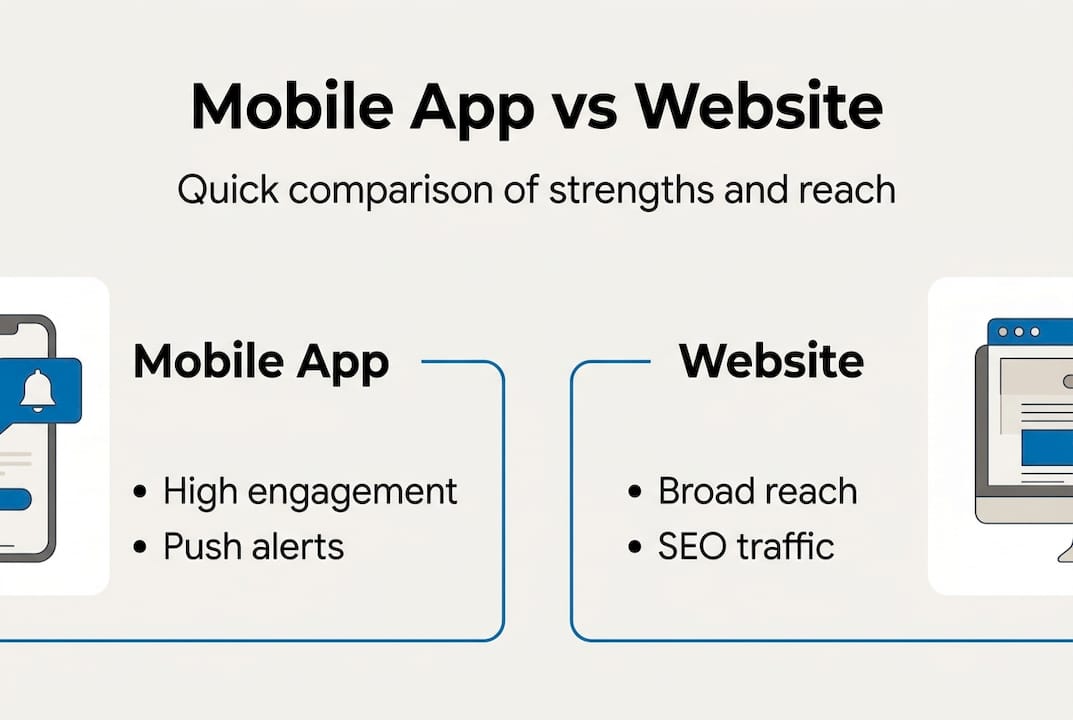
Consider a mid-size e-commerce brand. Their website handles product discovery, SEO traffic, and first-time purchases. Their app serves repeat customers with personalized recommendations, loyalty points, and faster checkout. Neither platform replaces the other. They work together.

For businesses focused on brand visibility and new customer acquisition, a high-quality website is the stronger investment. For businesses with an established customer base looking to deepen engagement, mobile app development becomes a compelling next step. If you are building from scratch, custom website development gives you the most flexible and cost-effective foundation.
Pro Tip: If you are not ready to commit to a full native app, a PWA can give you app-like features (offline access, home screen install, push notifications) at a fraction of the cost. It is a smart bridge strategy for growing businesses.
Cost, development, and maintenance considerations
Once you know the features, the next question is usually about the cost and commitment involved.
| Platform | Development cost | Timeline | Ongoing maintenance |
|---|---|---|---|
| Basic website | $5,000–$15,000 | 4–12 weeks | $500–$2,000/year |
| Advanced website | $15,000–$50,000 | 3–6 months | $2,000–$10,000/year |
| Basic mobile app | $40,000–$60,000 | 3–6 months | $10,000–$20,000/year |
| Complex mobile app | $100,000+ | 6–18 months | $20,000+/year |
A basic mobile app costs $40,000–$60,000 to develop, while a professional website often costs $5,000–$15,000, according to Clutch. That gap is significant for any small or mid-size business.
The main cost drivers for apps include:
- Platform choice: Building for both iOS and Android roughly doubles development time
- Custom integrations: Payment gateways, CRMs, and APIs add cost and complexity
- App store fees: Apple charges $99/year; Google charges a one-time $25 fee
- OS updates: Every major iOS or Android release may require code updates
- Cross-device support: Ensuring the app works across hundreds of device types takes ongoing effort
Websites carry lower upfront costs but still require investment in hosting, security certificates, performance optimization, and content updates. The concept of total cost of ownership matters here. Factor in not just build costs but the ongoing resources needed to keep the platform competitive.
For a detailed breakdown of what to budget, our guide on website development costs walks through every line item clearly.
Factors to consider when making your decision
You have seen the numbers, so how do you weigh everything to make a smart choice? Here are the five essential criteria:
- Target audience: Where does your audience spend their digital time? Older demographics and B2B buyers tend to use websites more. Younger, mobile-native consumers engage more with apps.
- Engagement goals: If you need repeat interactions, loyalty features, or real-time communication, apps have the edge. If you need discovery and lead generation, websites win.
- Budget: Be honest about what you can sustain long-term, not just what you can afford to build. Apps require ongoing investment.
- Required features: Offline access, camera integration, GPS, and biometric login are app-native features. Most informational or transactional needs are well served by a website.
- Future growth: Think 24 to 36 months ahead. Will your user base grow large enough to justify app adoption? Is your product complex enough to warrant a dedicated interface?
Your market location also matters. In the US and UK, mobile-first behavior is strong, but push notifications can increase app retention by up to 20%, according to Localytics. That retention advantage only applies if users actually download your app, which requires a compelling reason to do so.
Pro Tip: Before investing in an app, test enhanced website features first. Add live chat, a customer portal, or a booking system to your site. If engagement spikes, you have evidence that deeper functionality is worth pursuing. Explore custom website development solutions that can add these capabilities quickly.
How businesses apply mobile and web strategies in the real world
The right decision often comes to life through real-world execution.
Here is how different business types typically approach the mobile vs web decision:
- Local retailers and service businesses: Start with a responsive website optimized for local SEO. Add a booking or ordering feature. Evaluate app investment only after building a loyal customer base.
- SaaS startups: Often launch a web app first to validate the product, then build native mobile apps once they have paying users and investor backing.
- Hospitality and food brands: Frequently use both. A website drives discovery and reservations; an app handles loyalty rewards and repeat orders.
- Professional service firms: Websites remain the primary channel. Apps are rarely justified unless the service involves frequent client interaction or document sharing.
- Fitness and wellness brands: Strong app adoption due to daily usage patterns, personalization needs, and community features.
60% of small businesses invest first in a website, then develop apps as their digital strategy matures, according to Statista. This sequencing reflects practical wisdom, not limitation.
The web-first approach gives businesses time to understand their audience, refine their offering, and build the traffic base that makes an app launch viable. Skipping that foundation often leads to apps with no users. When you are ready to choose a development partner, knowing what to look for is critical. Our guide on choosing a web development partner covers the key questions to ask.
Why the best choice is rarely either/or
Let’s step back from features and costs and look at what actually works in practice.
After working across dozens of digital projects, one pattern stands out clearly: businesses that treat mobile app vs website as a permanent, one-time decision tend to get stuck. The ones that thrive treat it as an evolving strategy.
A website is not a consolation prize. It is the most accessible, discoverable, and cost-effective digital asset most businesses will ever own. Starting there is not settling. It is smart sequencing.
The contrarian truth is that pure app-first strategies almost always fail unless you already have a large, loyal audience or a product that genuinely requires native device features. Most businesses do not meet that bar when they first launch.
What works is iteration. Build a strong web presence. Learn what your users actually do. Then invest in deeper technology where the data tells you engagement is possible. That approach, guided by real behavior rather than assumptions, is what separates businesses that scale from those that stall. Our mobile web or app decision guide can help you map that path with clarity.
See what’s possible with the right digital partner
If you are ready to take the next step with confidence, we are here to help you move from decision to execution.

At Invisio Solutions, we have helped businesses across the UK and US build digital strategies that actually deliver results. Our work with Affinity UA is a strong example of what focused digital investment can achieve. Whether you need a high-performing responsive web design solution or a full app development roadmap, our team brings the expertise to guide every stage. We do not push you toward the most expensive option. We help you choose the right one. Reach out today and let’s build something that works for your business.
Frequently asked questions
Is a mobile app or website better for a small business?
A website is usually the best starting point for small businesses due to lower costs and broader reach. 60% of small businesses launch websites before apps, reflecting the practical advantages of web-first growth.
What are the top benefits of a mobile app over a website?
Mobile apps offer personalized experiences, offline access, and push notifications that keep users coming back. Push notifications drive up app retention by as much as 20%, making them a powerful tool for businesses with an engaged user base.
Are websites still necessary if you have an app?
Yes, a website remains essential for SEO, organic discovery, and users who prefer not to download an app. Mobile websites drive higher organic reach consistently, which no app can fully replace.
How much does it cost to develop a basic app vs website?
A basic app typically costs $40,000–$60,000 to develop, while a professional website may cost $5,000–$15,000, making websites the more accessible starting point for most businesses.
Recommended