
Unlock actionable insights with social media audience research

TL;DR:
- Audience research reveals platform-specific demographics and behaviors to optimize social media strategies.
- Analyzing metrics like reach and engagement helps identify high-performing content and audience overlaps.
- Using detailed insights ensures targeted messaging, reduces wasted ad spend, and improves ROI.
Most marketers treat social media like a single channel with one audience. They post the same content everywhere and wonder why results vary so wildly. The reality is that YouTube leads US usage at 84%, while platforms like TikTok and Instagram skew heavily toward younger demographics. Each platform attracts a distinct crowd with different expectations, habits, and content preferences. Without proper audience research, you are essentially guessing. This guide breaks down why audience research matters, which methods actually work, how to interpret the data you collect, and how to turn those insights into campaigns that drive real ROI.
Table of Contents
- Why audience research matters in 2026
- Core methods for social media audience research
- Deciphering platform data: What the numbers actually mean
- Applying audience insights to marketing strategy
- The overlooked power of granular social insights
- Level up your social strategy with Invisio Solutions
- Frequently asked questions
Key Takeaways
| Point | Details |
|---|---|
| Audience research is essential | Understanding your social audience prevents wasted budget and improves ROI. |
| Platform demographics differ | Each social network appeals to distinct age groups and usage patterns. |
| Actionable data drives strategy | Using segmented audience insights empowers targeted content and campaigns. |
| Interpret data wisely | Don’t just collect numbers—identify trends and test changes for real results. |
Why audience research matters in 2026
Social media demographics are not static. They shift every year, sometimes dramatically. A strategy that worked in 2023 may be completely misaligned with where your audience actually spends time today. Marketers who skip audience research are not just behind. They are actively wasting budget on the wrong platforms, the wrong formats, and the wrong messages.
Let’s ground this in numbers. According to Pew Research, US social media platform usage currently sits at YouTube (84%), Facebook (71%), Instagram (50%), and TikTok (37%). But raw usage figures only tell part of the story. The generational split is where things get interesting. Instagram reaches 80% of US adults aged 18 to 29, but that number drops significantly among adults over 50. That gap matters enormously when you are deciding where to allocate your paid and organic efforts.
Understanding which top social media platforms your audience actually uses is the foundation of any effective strategy. Platform-specific behavior is equally important. What resonates on TikTok, short-form, fast-paced, trend-driven video, will often fall flat on Facebook, where longer posts, community groups, and shared articles tend to perform better. Treating these platforms as interchangeable is one of the most expensive mistakes a marketing team can make.
“Instagram is used by 80% of US adults aged 18 to 29, compared to far lower rates among those 50 and older. Assuming your Instagram audience mirrors your overall customer base is a critical planning error.”
Skipping audience research creates a predictable set of problems. Here is what typically goes wrong:
- Wasted ad budget on platforms where your core audience is not active
- Poor engagement rates because content format does not match platform norms
- Tone-deaf messaging that misses cultural or generational nuances
- Missed audience segments that could be highly profitable with the right approach
- Slow iteration because there is no baseline data to measure improvements against
The good news is that fixing this does not require a massive research budget. It requires the right methods and a commitment to letting data lead decisions.
Core methods for social media audience research
With the case for research firmly established, the next step is knowing where to start. There are three primary data sources available to most marketing teams: native platform analytics, direct audience surveys, and third-party research tools. Each has distinct strengths.
| Research method | Pros | Cons |
|---|---|---|
| Native analytics (Meta Insights, TikTok Analytics) | Free, real-time, platform-specific | Limited cross-platform view |
| Audience surveys (Typeform, Google Forms) | Rich qualitative data, direct feedback | Low response rates, time-intensive |
| Third-party tools (Sprout Social, Brandwatch) | Broad data, competitor benchmarking | Cost, learning curve |
Running a basic audience audit does not need to be complicated. Follow these steps to get started:
- Export your native analytics from each platform you use (at minimum, the last 90 days of data).
- Identify your top-performing content by reach, engagement rate, and saves or shares.
- Pull demographic breakdowns including age, gender, and location for each platform separately.
- Compare your actual audience against your assumed target customer profile.
- Note the gaps where your content is reaching people outside your intended demographic.
- Set a benchmark so you can measure whether future changes improve alignment.
One critical insight from current data: daily TikTok use reaches 24% among young adults, making it a high-frequency touchpoint that demands consistent, platform-native content. If your brand is targeting that demographic, the frequency and format of TikTok content needs to reflect that usage pattern.
Our social media marketing services are built around exactly this kind of data-led approach. For teams just getting started, reviewing how to boost social media presence with proven tactics is a strong foundation. Understanding the pros and cons of social media for your specific business type also helps frame realistic expectations.
Pro Tip: Always segment your audit results by age, gender, and location before drawing conclusions. A single average figure can mask two completely different audience groups behaving in opposite ways.
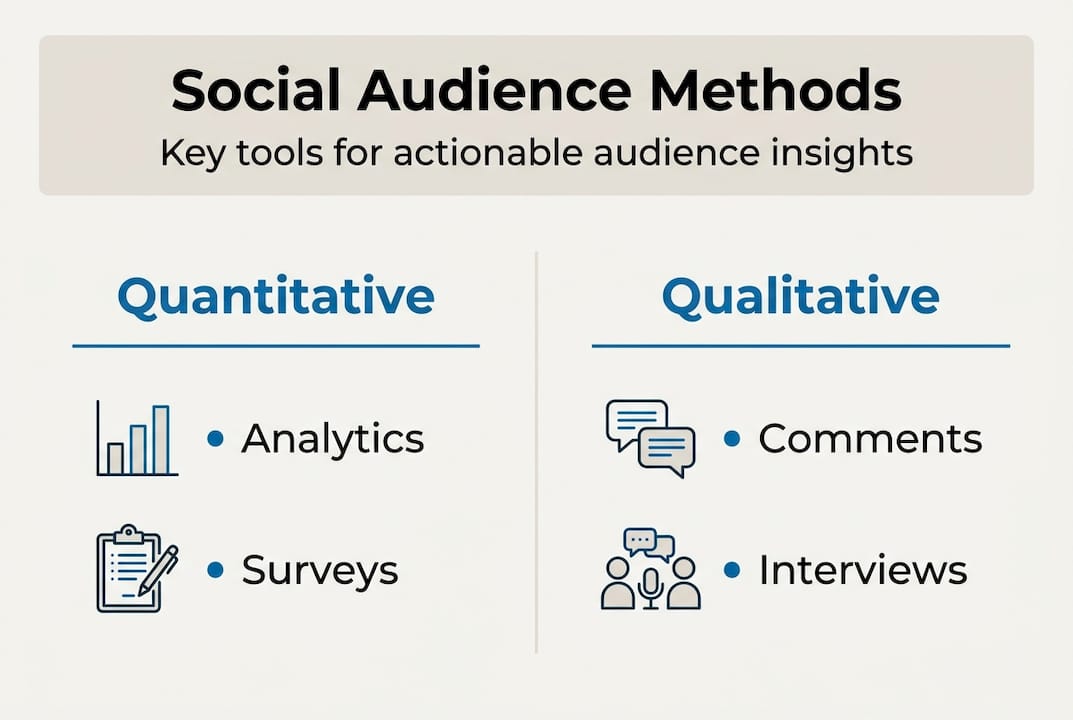
Combining quantitative data (numbers from analytics) with qualitative data (survey responses, comment analysis) gives you a far more accurate picture. Numbers tell you what is happening. Qualitative feedback tells you why.
Deciphering platform data: What the numbers actually mean
Collecting data is only half the job. Interpreting it correctly is where most teams struggle. Raw numbers without context lead to bad decisions just as easily as no data at all.
Start with the four metrics that matter most for audience research:
- Reach is how many unique accounts saw your content. High reach with low engagement suggests your content is visible but not resonating.
- Engagement rate measures interaction relative to reach. A small, highly engaged audience is often more valuable than a large passive one.
- Audience overlap across platforms tells you whether you are reaching the same people repeatedly or genuinely expanding your footprint.
- Psychographics go beyond demographics to capture interests, values, and purchase motivations. These come from comment analysis, survey responses, and third-party tools.
Here is a simplified example of what platform audience data might look like for a mid-size brand:
| Platform | Primary age group | Avg. engagement rate | Top content type | Notes |
|---|---|---|---|---|
| YouTube | 25 to 44 | 4.2% | Long-form tutorials | High intent, research-driven |
| 35 to 54 | 1.8% | Articles, community posts | Broad reach, lower frequency | |
| 18 to 34 | 3.6% | Reels, product visuals | Visual-first, trend-sensitive | |
| TikTok | 18 to 29 | 5.9% | Short-form video | Fast-moving, requires volume |
TikTok and Instagram see dramatically higher usage among Gen Z compared to older demographics, which means brands targeting a 35-plus audience should not mirror their TikTok strategy on Facebook. The content, tone, and cadence need to be platform-specific.
Watching for sudden changes in your audience data is equally important. A spike in teen followers might signal that a piece of content went viral in an unintended community. A drop in engagement from your core demographic could mean the algorithm has shifted or your content has drifted off-brand. Staying current with content trends for 2024 and beyond helps you contextualize these shifts.
Common misinterpretations to avoid:
- Assuming all followers see every post. Organic reach on most platforms is well below 10% of your follower count.
- Confusing reach with engagement. A post seen by 50,000 people but liked by 100 is not performing well.
- Treating follower count as a success metric. Follower growth without engagement growth is a vanity metric.
Applying audience insights to marketing strategy
Data without action is just noise. The real value of audience research comes from how you apply it to content creation, targeting, and campaign planning.
Here is a practical process for integrating your findings:
- Map your audience segments to specific platforms based on where they are most active.
- Adjust content formats to match platform-native preferences (Reels for Instagram, long-form for YouTube, trending audio for TikTok).
- Refine your ad targeting using demographic and psychographic data to narrow your paid audience.
- Update your messaging to reflect the language, tone, and values your research reveals your audience responds to.
- Set platform-specific KPIs so you are measuring success against the right benchmarks for each channel.
Consider a real scenario. A retail brand assumes its core audience is women aged 30 to 45. After running an audience audit, they discover that 38% of their Instagram engagement is coming from women aged 18 to 24. That is a significant untapped segment. Rather than ignoring it, they create a secondary content stream targeting that group with different product lines and messaging. Sales from that segment increase within two months.

Gen Z favors TikTok and Instagram, which means brands cannot apply a single content strategy across all platforms and expect consistent results. The format, pacing, and cultural references need to match the platform and the audience using it. Leveraging AI for B2B marketing can also help automate audience segmentation and personalize content at scale.
Pro Tip: Before scaling any new insight-led campaign, run a small test with a limited budget first. Two weeks of testing with a focused audience segment will tell you far more than any spreadsheet, and it protects your budget if the hypothesis is wrong.
Platform-specific insights consistently outperform one-size-fits-all messaging. The brands winning on social media in 2026 are the ones treating each platform as its own ecosystem with its own rules.
The overlooked power of granular social insights
Most brands approach audience research at the surface level. They check follower counts, glance at age breakdowns, and call it done. That is not research. That is a quick look before moving on to content production.
The real competitive edge comes from going deeper. We have seen campaigns transform when a brand discovers that their most engaged audience segment is not who they assumed. One client found that their highest-converting Instagram followers were not in their target city. They were in a secondary market the brand had never considered. That single finding shifted their geo-targeting and reduced cost per acquisition by a meaningful margin.
Shortcutting research in favor of content volume almost always backfires. More posts do not fix a misaligned audience. They just amplify the mismatch. The brands that test first, listen carefully, and scale only what works are the ones building durable social media presence.
When the research goes beyond what an in-house team can manage, working with expert social media services ensures you get the depth of insight that actually moves the needle. Granular data is not a luxury. It is the difference between guessing and knowing.
Level up your social strategy with Invisio Solutions
Understanding your social media audience is one thing. Acting on those insights consistently is another. At Invisio Solutions, we help businesses move from scattered posting to strategic, data-led social media programs that actually grow.
Our social media marketing services cover everything from audience audits and content strategy to paid social management and performance reporting. Whether you are based in the US or the UK, our team at social media services London brings proven expertise to every campaign. If you are ready to boost your social media with a strategy built on real audience data, we are ready to help you get there.
Frequently asked questions
What is social media audience research?
Social media audience research is the process of analyzing data to understand the behaviors, preferences, and demographics of people engaging with your social platforms. Platform demographics vary widely, making this research essential for accurate targeting.
What data should I focus on during audience research?
Focus on metrics like age, location, engagement rates, interests, and which platforms your audience prefers. Younger audiences dominate TikTok and Instagram, so platform-specific focus is critical for brands targeting Gen Z.
How often should I conduct audience research?
Review your audience insights at least quarterly to keep pace with fast-changing trends and shifts in platform usage. Social media demographics shift rapidly, meaning annual reviews leave you working with outdated assumptions.
How does audience research improve marketing ROI?
Audience research allows you to tailor content and ad targeting for better engagement and reduced wasted spend. When your message reaches the right people on the right platform, every dollar works harder.
Recommended
- Social Media Agency, Social Media Marketing Services London UK
- Boost Your Business: Top 6 Social Media Platforms For Business Growth
- Content Trends And Predictions For 2024 | Invisio Solutions
- Google Ads Vs. Facebook Ads: Choosing The Right PPC Strategy
- Pocket App | The Power of Mobile Analytics: Leveraging Data for App Success