
Social media analytics: boost ROI with smarter data

Most businesses post consistently on social media, track their likes, and call it a day. That approach leaves serious money on the table. Social media analytics involves collecting, measuring, and interpreting data from social platforms to inform marketing decisions, focusing on metrics like engagement rate, reach, impressions, sentiment, and ROI. When you move beyond surface-level numbers, you gain the kind of clarity that turns a guessing game into a growth engine. This guide walks you through the types of analytics, the metrics that actually matter, the best tools for 2026, and how to apply every insight to drive real business results.
Table of Contents
- What is social media analytics?
- Key social media metrics to track
- Top social media analytics tools for 2026
- How social media analytics informs marketing strategy
- Real-world examples: boosting ROI with social media analytics
- Ready to level up with expert-led social media analytics?
- Frequently asked questions
Key Takeaways
| Point | Details |
|---|---|
| Analytics are critical | Going beyond vanity metrics with analytics enables smarter, ROI-focused marketing. |
| Track key metrics | Focus on engagement, reach, sentiment, and ROI for the most actionable insights. |
| Use the right tools | Leverage specialized analytics platforms to gather, visualize, and act on data efficiently. |
| Data guides strategy | Turn social insights into marketing improvements for real, measurable business growth. |
What is social media analytics?
Social media analytics is not just a dashboard full of numbers. It is a structured process of collecting and interpreting social data to inform marketing decisions. That means going well beyond follower counts and post likes to understand how your audience actually behaves, what content resonates, and where your campaigns are winning or losing.
There are three levels of analytics every marketer should recognize. Descriptive analytics tells you what happened, such as how many people saw your post last Tuesday. Diagnostic analytics explains why it happened, revealing that Tuesday posts outperform Monday ones because your audience is most active mid-week. Predictive analytics uses historical patterns to forecast what might happen next, helping you plan smarter campaigns before you spend a dollar.
“Vanity metrics like follower count feel good but rarely connect to revenue. The real value is in understanding behavior, intent, and conversion patterns.”
Surface metrics are not useless, but they are incomplete. A post with 10,000 likes and zero conversions is not a win. Serious marketing decisions require data that connects social activity to business outcomes. That is the core promise of analytics done right.
Key social media metrics to track
Once you understand what analytics encompass, it becomes crucial to know which metrics to monitor and why they matter. Not every number deserves equal attention. The goal is to focus on metrics that reflect real performance and align with your business objectives.
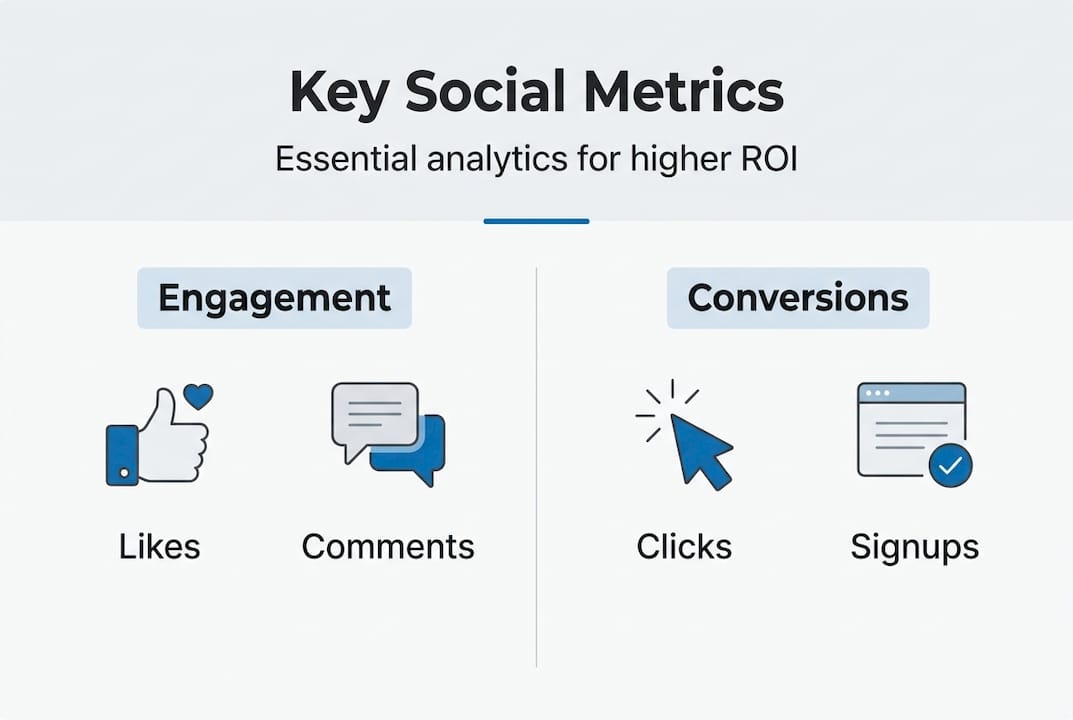
Key metrics include engagement rate, reach, impressions, sentiment, and ROI. Here is a breakdown of what each one means and why it matters:
| Metric | What it measures | Why it matters |
|---|---|---|
| Engagement rate | Interactions divided by reach or impressions | Shows how well content resonates with your audience |
| Reach | Unique accounts that saw your content | Measures actual audience exposure |
| Impressions | Total times content was displayed | Tracks visibility and frequency |
| Conversion rate | Actions taken divided by total visitors | Directly ties social activity to business goals |
| Sentiment score | Positive vs. negative mentions | Reveals brand perception in real time |
| ROI | Revenue generated vs. spend | Proves the financial value of social campaigns |
Sentiment analysis is growing fast as a priority metric. It goes beyond counting mentions to understanding the emotional tone behind them. A spike in brand mentions sounds great until you realize most of them are complaints. Sentiment tracking catches that early.
Pro Tip: Set up a weekly metrics review that covers at least three of these six metrics. Rotate your focus monthly so you build a full picture of performance over time rather than fixating on one number.
Businesses that track outcome-driven metrics consistently are far better positioned to justify social media budgets and optimize campaigns in real time. That is not a minor advantage. It is the difference between a strategy and a shot in the dark.
Top social media analytics tools for 2026
With key metrics in focus, the next step is choosing a platform that delivers the insights you need. The right tool depends on your budget, the platforms you use, and how deep you need to go with reporting.
Choosing the right analytics tool helps marketers capture and utilize engagement, reach, and ROI data efficiently. Here is a comparison of leading options:
| Tool | Supported networks | Pricing | Standout feature |
|---|---|---|---|
| Native platform insights | Platform-specific | Free | Real-time data, no setup required |
| Google Analytics 4 | All (via UTM links) | Free | Cross-channel attribution and conversion tracking |
| Sprout Social | All major platforms | From $249/month | Advanced reporting and team collaboration |
| Hootsuite | All major platforms | From $99/month | Scheduling plus analytics in one dashboard |
| Buffer Analyze | Instagram, Facebook, X | From $6/month | Affordable, clean reporting for small teams |
When selecting a tool, consider these factors:
- Budget: Free tools work for basics; paid platforms unlock deeper segmentation and automation
- Integration: Does it connect with your CRM, email platform, or AI marketing tools?
- Reporting depth: Can it generate the reports your stakeholders actually need?
- Automation: Does it alert you to anomalies or schedule reports automatically?
- Support: Is there onboarding help or a knowledge base for your team?
For most growing businesses, starting with native insights plus Google Analytics 4 covers the essentials at zero cost. As your campaigns scale, investing in a dedicated platform pays off quickly through time saved and insights gained.
How social media analytics informs marketing strategy
Armed with the right tools, it is time to put analytics into action within your broader marketing framework. Data without action is just noise. The real value comes from building a repeatable process that turns numbers into decisions.
Analytics shifts strategies from intuition-based to data-driven, enabling optimized campaigns and better ROI. Here is a proven reporting cycle you can implement right now:
- Review: Pull your weekly or monthly data across all active platforms
- Analyze: Identify patterns, outliers, and underperforming content
- Act: Adjust targeting, posting times, content formats, or ad spend based on findings
- Measure: Track the impact of those changes in the next reporting cycle
Consider a practical example. A retail brand runs a paid social campaign promoting a seasonal sale. By tracking click-through rate, conversion rate, and cost per acquisition in real time, they notice that video ads on Instagram outperform static images by 40%. They reallocate budget mid-campaign. The result is a lower cost per sale and a higher overall return.

Analytics also refines your targeting. If your data shows that 35 to 44-year-old women in urban areas engage most with your content, you can build lookalike audiences and adjust your messaging to match. That level of precision is only possible when you are reading the data consistently.
The role of AI in digital marketing is accelerating this process. AI-powered analytics platforms can now surface insights automatically, flag performance drops before they become problems, and even recommend content adjustments based on historical data.
Pro Tip: Segment your analytics by platform and audience group. Instagram and LinkedIn audiences often behave very differently, even for the same brand. Treating them as one group masks the insights that could improve both.
Real-world examples: boosting ROI with social media analytics
These use cases show just how powerful analytics-driven social strategies can be in practice. Real results come from brands that commit to the process, not just the tools.
Example 1: E-commerce brand doubles engagement
An online fashion retailer was posting daily but seeing flat engagement. After a full analytics audit, they discovered that carousel posts published on Wednesday evenings generated three times the saves and shares of standard image posts. They restructured their content calendar around this insight. Within 60 days, overall engagement rate doubled and website traffic from social increased by 38%.
- Metrics tracked: Engagement rate, saves, shares, referral traffic
- Insight gained: Content format and timing were the primary performance drivers
- Change made: Shifted to carousel-heavy schedule with optimized posting windows
Example 2: B2B firm increases qualified leads
A software company was generating high impressions on LinkedIn but low lead volume. Analytics revealed that long-form thought leadership posts drove significantly more profile visits and connection requests than promotional content. They shifted their content mix to 70% educational and 30% promotional. Lead quality improved, and cost per lead dropped by 22% over one quarter.
- Metrics tracked: Impressions, profile visits, lead form completions, cost per lead
- Insight gained: Educational content builds trust and drives higher-intent actions
- Change made: Rebalanced content strategy toward value-first messaging
“Analytics can drive tangible business improvement and demonstrate ROI for social marketing programs, turning data into a competitive advantage.”
Both examples share a common thread. Systematic analytics review guided every decision. There was no guessing, no gut-feel pivots. Just clear data pointing to clear actions. You can explore more about building this kind of social media marketing success for your own brand.
Ready to level up with expert-led social media analytics?
Understanding analytics is one thing. Executing a data-driven social strategy consistently, across multiple platforms, while running a business, is another challenge entirely. That is where expert partnership makes a real difference.
At Invisio Solutions, our team specializes in turning raw social data into strategies that grow your brand and improve your bottom line. From campaign setup to performance reporting, we handle the complexity so you can focus on your business. Our social media agency solutions are built for businesses that want measurable results, not just more posts. See how we delivered real outcomes in the Affinity UA case study and find out what a focused analytics strategy could do for your brand. Reach out today for an initial assessment.
Frequently asked questions
What is the difference between social media metrics and analytics?
Metrics are raw data points like likes and impressions, while analytics interpret these numbers to reveal trends and drive strategy. One tells you what happened; the other tells you what to do about it.
Which social media metric has the biggest impact on ROI?
Conversion rate and engagement rate usually have the strongest connection to ROI, but the most important metric depends on your campaign goals. Key metrics like reach and sentiment also play a role depending on whether you are focused on awareness or direct response.
Can small businesses afford social media analytics tools?
Yes. Many platforms offer free tiers or low-cost plans that are well-suited to smaller teams. Choosing the right tool means matching features to your actual needs rather than paying for enterprise-level capabilities you will not use.
How often should you review social media analytics?
Most brands benefit from weekly reviews to catch performance shifts early, with deeper monthly or quarterly analysis used for strategic adjustments and budget planning.
Recommended