
Master the graphic design process for stronger branding

Graphic design is not decoration. It is one of the most measurable drivers of business performance available to marketing leaders today. Consistent branding boosts revenue by 23% and brand recognition by up to 80%, yet most businesses still treat design as an afterthought rather than a strategic investment. If your team is producing visuals without a repeatable, structured process behind them, you are leaving real money on the table. This guide breaks down the full graphic design process, from research to rollout, so you can build stronger branding, reduce wasted effort, and get measurable results from every design dollar you spend.
Table of Contents
- What is the graphic design process?
- The 7 essential stages of effective graphic design
- Strategy first: Why planning beats pure aesthetics
- Balancing creativity and consistency: Style guides and real-world testing
- AI and the modern design process: How automation changes the game
- Measuring success: ROI and branding outcomes from a better process
- Bringing structure and creativity to your business design projects
- Frequently asked questions
Key Takeaways
| Point | Details |
|---|---|
| Strategy comes first | Start with research and planning for designs that drive results. |
| Consistency builds brands | Use guidelines and test across touchpoints to maintain brand recognition. |
| AI is a tool, not a replacement | Leverage AI for speed but rely on humans for brand strategy and nuance. |
| Success is measurable | Track revenue, recognition, and engagement to gauge design ROI. |
| Professional support pays off | Working with experts and clear processes maximizes graphic design investment. |
What is the graphic design process?
The graphic design process is a structured sequence of steps that transforms a business objective into a visual solution. It is not simply about choosing colors or fonts. In a business context, it is about creating assets that communicate your brand’s value clearly, consistently, and memorably across every customer touchpoint.
Our graphic design services are built around this principle: structure produces results. A well-run graphic design workflow removes guesswork, reduces revision cycles, and keeps creative output aligned with business goals. The process typically uses a structured 6-8 step methodology with a focus on strategy, ensuring that every visual decision serves a purpose.
Here is why this matters at scale:
- Consistency builds trust and recognition across all channels
- Clarity ensures your message lands with the right audience
- Brand strength compounds over time when design is systematic
73% of companies invest in design specifically to outperform competitors. That statistic alone should reframe how your leadership team thinks about the design budget.
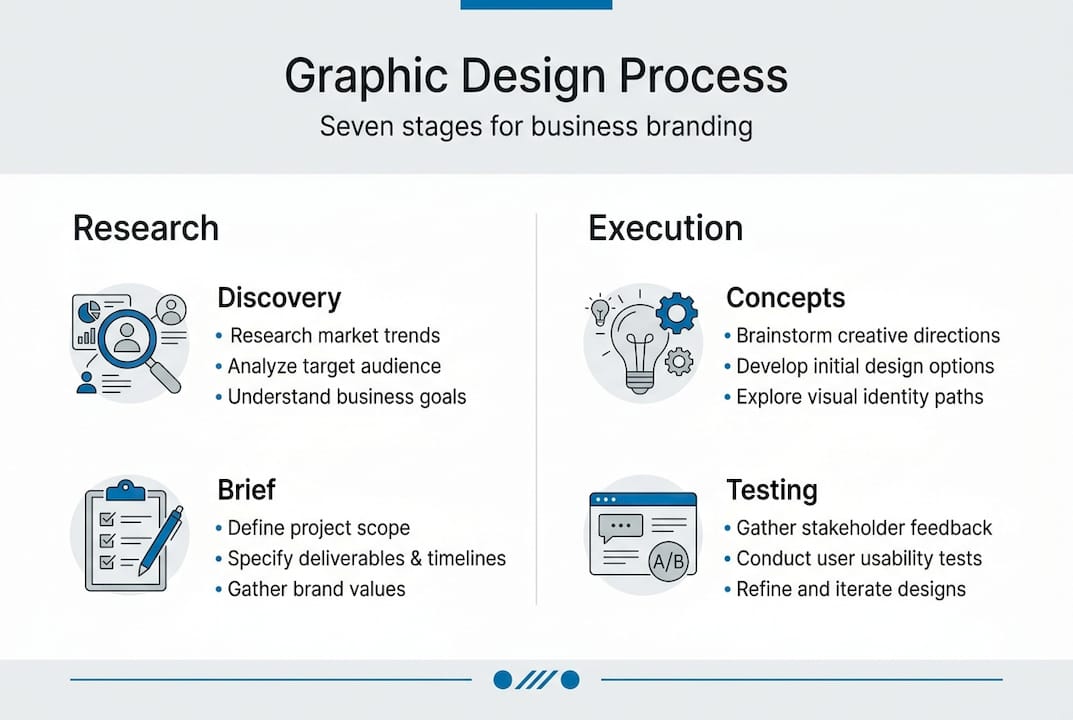
| Phase | Typical timeline | Business outcome |
|---|---|---|
| Discovery and research | 1-2 weeks | Aligned brief and audience clarity |
| Strategy and positioning | 1-2 weeks | Defined brand direction |
| Ideation and concepts | 1-2 weeks | Creative options for review |
| Design and refinement | 2-4 weeks | Polished, on-brand assets |
| Testing and feedback | 1 week | Validated, market-ready output |
| Delivery and implementation | 1-2 weeks | Live assets across all channels |
Explore our online graphic design services if you want to see how this structure translates into real deliverables for businesses like yours.
The 7 essential stages of effective graphic design
Leading agencies follow a proven sequence. A typical business design project includes 7 core steps, from research to ongoing maintenance. Here is what each stage involves and why it matters:
- Research — Gather data on your audience, competitors, and market position. Ask: Who are we designing for, and what do they already respond to?
- Strategy — Define your brand positioning, tone, and visual direction. Ask: What do we want to be known for?
- Ideation — Sketch concepts, explore directions, and generate options without committing to execution yet.
- Digital design — Build polished assets using the approved direction. This is where custom logo design services and full branding and identity design come to life.
- Feedback and revision — Present work to stakeholders, gather structured input, and refine based on clear criteria.
- Delivery — Package and hand off final files in all required formats for print, digital, and social use.
- Implementation and maintenance — Roll out assets across channels and update guidelines as the brand evolves.
For a deeper look at how this applies specifically to logos, the logo design process from concept to creation is a useful reference.
Pro Tip: Document your design brief and style guidelines before any creative work begins. Teams that skip this step spend an average of 30% more time on revisions because the goalposts keep moving.
Strategy first: Why planning beats pure aesthetics
Here is a mistake we see constantly. A business invests in design, skips the strategy phase, and ends up with visuals that look polished but feel disconnected from the brand. The result is wasted budget and a rebrand six months later.
Strategy before aesthetics is the expert path for brand results. Before any creative work starts, your team needs clear answers to these questions:
- What do we want to be known for in our market?
- Who is our target customer, and what visual language resonates with them?
- How do we differ from our top three competitors?
- What emotions should our brand trigger at first glance?
Common pitfalls that derail design projects include skipping audience research, leaving brand positioning vague, and chasing visual trends that do not align with the brand’s actual values. Each of these mistakes is avoidable with a solid brief.
“Design without strategy is just decoration. Strategy-led design is an investment that compounds with every customer interaction.”
A strong branding strategy for businesses starts with these foundational questions answered in writing, agreed upon by key stakeholders, before a single concept is sketched. Building a consistent brand identity from the start saves significant time and budget downstream.
Balancing creativity and consistency: Style guides and real-world testing
Once strategy is locked in, the next challenge is keeping design consistent as assets multiply across teams, vendors, and channels. This is where style guides become essential tools, not optional extras.
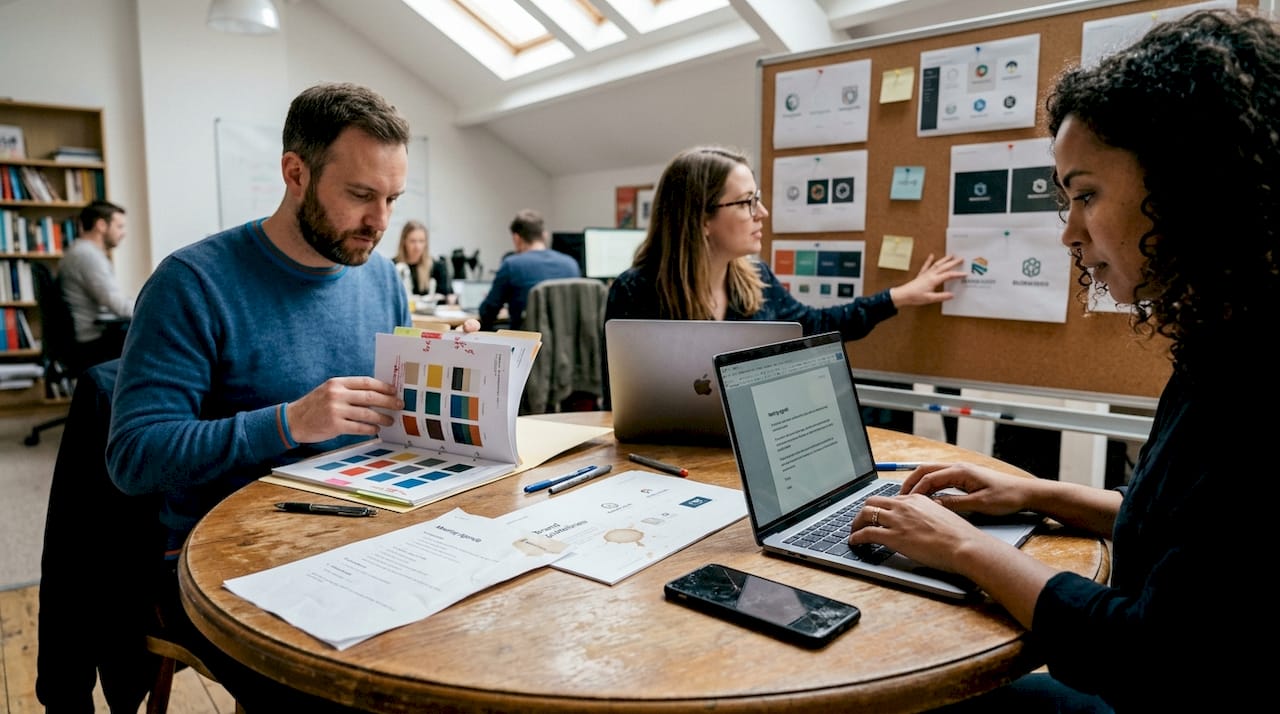
A basic style guide covers logo usage rules, color palette with exact hex and CMYK values, typography hierarchy, and image tone. A more detailed guide adds voice and tone guidelines, iconography rules, layout grids, and approved templates for common formats. Comprehensive guidelines and prioritizing edge cases preserve consistency and reduce brand dilution as your organization scales.
Real-world testing is equally important. Before finalizing any asset, check it across these touchpoints:
- Website headers and mobile views
- Social media profile images and post formats
- Print materials including business cards and brochures
- Email signatures and newsletter templates
- Outdoor signage and merchandise
- Black and white versions for fax or single-color printing
For a practical breakdown of how this fits into the broader graphic design process explained, testing at multiple sizes and contexts often reveals weaknesses that look invisible on screen.
Pro Tip: Fast-growing teams should start with just three core assets: logo, color palette, and primary typeface. Lock those down with clear rules before expanding the guide. Trying to document everything at once leads to guides that nobody actually uses.
Your branding guidelines should be a living document, updated every time a new asset category is introduced.
AI and the modern design process: How automation changes the game
AI tools have genuinely changed what is possible in a design workflow. They are fast, scalable, and useful for specific tasks. But they are not a replacement for strategic thinking.
AI can speed up design by up to 50-60%, particularly in the ideation and variation stages. That is a real productivity gain. However, AI still requires human strategy input to produce work that is culturally appropriate, on-brand, and aligned with business goals. For a balanced view of AI’s role in design, the consensus is clear: AI augments skilled designers, it does not replace them.
| Factor | Traditional process | AI-augmented process |
|---|---|---|
| Ideation speed | 3-5 days | Hours |
| Variation generation | Manual, time-intensive | Rapid and scalable |
| Strategic alignment | Human-led | Still requires human oversight |
| Cultural nuance | Strong with experienced team | Inconsistent without review |
| Final quality control | Designer-driven | Human review essential |
Here is a practical checklist for adopting AI in graphic design without losing quality:
- Use AI for initial concept exploration and color palette generation
- Always have a senior designer review AI output for brand fit
- Never use AI-generated assets without checking for copyright and originality issues
- Set clear internal policies on which stages AI tools are permitted
- Treat AI as a starting point, not a finished product
Measuring success: ROI and branding outcomes from a better process
Knowing your design process is structured is one thing. Proving it delivers results to leadership is another. The good news is that design ROI is measurable when you track the right metrics.
Design-focused firms are 69% more likely to exceed business targets and consistent branding can boost revenue by 23%. Those are board-level numbers. Your job is to connect design activity to those outcomes with data. For broader context, design statistics consistently show that investment in structured design processes outperforms ad hoc approaches.
| Metric | Industry benchmark | What to track |
|---|---|---|
| Brand recognition | 60-80% recall in target market | Surveys and aided recall tests |
| Engagement rate | 2-5% on social content | Platform analytics |
| Conversion rate | 2-4% for landing pages | A/B testing with design variants |
| Revenue growth | 10-23% with consistent branding | Year-over-year comparison |
To build effective reporting for leadership, follow these steps:
- Tie every design project to a specific business objective before it starts
- Set baseline metrics before launching new brand assets
- Report on engagement, conversion, and recognition quarterly
- Use before-and-after comparisons to show the impact of rebrands or refreshes
- Present findings in plain language, not design jargon
Working with a professional design agency that understands both creative execution and business metrics makes this reporting process significantly easier.
Bringing structure and creativity to your business design projects
A structured graphic design process is not a constraint on creativity. It is the foundation that makes creativity effective. When strategy, consistency, and measurement work together, your design investments produce compounding returns rather than one-off wins.
At Invisio Solutions, we bring both creative expertise and strategic discipline to every project. If you want to see what a structured design process looks like in practice, our Affinity UA case study shows exactly how we approach branding challenges for real businesses. We also integrate design with broader digital strategy, including responsive web design solutions that ensure your brand looks and performs consistently across every device. Ready to assess your current design workflow or start a new project? Our team is here to help you build something that lasts.
Frequently asked questions
How long does the typical graphic design process take for a business project?
Most business design projects range from 1-4 weeks for logos and 8-12 weeks for complete brand identities, depending on complexity and the number of revision rounds.
What should a business include in a design project brief?
A design brief should cover business goals, target audience, key competitors, brand values, and intended outcomes. Briefs covering audience and competitors consistently produce better creative results with fewer revisions.
Can you skip to the design phase without research and strategy?
Skipping research and strategy significantly increases the risk of off-brand results and wasted budget. Strategy before aesthetics is the proven path to design that actually delivers business outcomes.
How is AI used in the modern graphic design process?
AI tools accelerate ideation and variation generation, but they work best when guided by human strategy. AI is best for speed, while human designers ensure the output is on-brand and strategically sound.
How can I tell if my design process is working?
Track revenue growth, brand recognition scores, and audience engagement over time. Design-driven firms see 23% revenue boosts and higher engagement, making these the clearest indicators of process effectiveness.
Recommended
- Graphic Design Services | Your Brand With Invisio Solutions
- Best Logo Designers Professionals For Your Brand Identity
- Custom Logo Design Services | Professional Brand Identity Solutions
- Graphic Design Services London UK, Top Designers Agency UK
- Death to Generic Digital Experiences: The Rise of Unique Design