
How to Personalize Content for Maximum Engagement and ROI

Personalization isn’t just a buzzword. It’s a proven revenue driver. Personalized content strategies deliver 20% sales increases, 15% higher ROI, and conversion boosts up to 67%. For digital marketers at small to mid-sized businesses, these numbers represent real growth potential. The challenge isn’t whether to personalize, it’s how to do it effectively without overwhelming your team or budget. This guide walks you through the entire process, from foundational data practices to advanced AI-driven tactics, giving you a clear roadmap to transform generic content into targeted experiences that drive measurable results.
Table of Contents
- What makes content personalized?
- Preparing for personalization: Data and privacy foundations
- Step-by-step: How to personalize your content
- Testing, validation, and avoiding common pitfalls
- The future: Human oversight, AI, and evolving best practices
- Unlock more value with expert personalization solutions
- Frequently asked questions
Key Takeaways
| Point | Details |
|---|---|
| Start with strong data | Use zero- and first-party data to power safe and effective personalization. |
| Follow a proven process | Segment, map, and adapt your content—then automate with AI and test for results. |
| Prioritize privacy | Transparency and user control prevent privacy pitfalls and increase trust. |
| Continuous improvement | A/B test and validate conversions to maximize ROI as strategies evolve. |
| Combine AI and human input | Let AI handle scale while humans ensure brand voice and ethical content. |
What makes content personalized?
Content personalization means adapting what your audience sees based on who they are, what they’ve done, and where they are in their journey. It’s not guesswork. It’s data-driven content adaptation using three core data types: demographic information like age and location, behavioral signals such as past purchases or page views, and contextual factors including device type or time of day.
The sophistication of your personalization depends on your approach. Basic segmentation groups users by shared traits. Rule-based systems trigger specific content when conditions are met. Machine learning models predict preferences based on patterns. Real-time AI adapts content instantly as users interact. Each level requires more technical investment but delivers increasingly precise targeting.
What does personalization look like in practice? Here are the most effective applications:
- Email campaigns with subject lines and offers tailored to recipient behavior
- Website recommendations showing products or content based on browsing history
- Dynamic landing pages that change headlines and imagery by traffic source
- Chatbot responses adapting tone and suggestions to user questions
- Product feeds prioritizing items aligned with past purchases
Choosing the right approach depends on your data maturity and resources. This table shows how different personalization methods align with the data you need:
| Personalization Approach | Data Required | Technical Complexity | Best For |
|---|---|---|---|
| Basic Segmentation | Demographics, location | Low | Email campaigns, broad audience groups |
| Rule-Based Dynamic Content | Behavioral triggers, page views | Medium | Website personalization, cart abandonment |
| Machine Learning Models | Historical patterns, purchase data | High | Product recommendations, predictive content |
| Real-Time AI Adaptation | Live contextual signals, session data | Very High | Instant personalization, chatbots |
Small businesses often start with email segmentation and basic website personalization because these deliver strong ROI without requiring extensive technical infrastructure. Tools like small business marketing tools make it easier to implement these strategies without a dedicated data science team. As you collect more data and prove results, you can layer in more sophisticated AI content personalization techniques.
Preparing for personalization: Data and privacy foundations
Before launching any personalization initiative, you need a solid data foundation built on trust. The most valuable data comes directly from your users. Zero-party data is information customers intentionally share through preferences, surveys, or account settings. First-party data includes behavioral signals you collect from your own properties like website analytics and purchase history.

These data types matter more than ever because third-party cookies are disappearing. Privacy-first personalization strategies require transparency, user control, and data minimization. When you’re upfront about what you collect and why, users are more willing to share information. Give them clear options to manage their preferences and only collect what you’ll actually use.
Building trust through privacy practices:
- Display clear privacy policies explaining data usage in plain language
- Offer granular consent options instead of all-or-nothing choices
- Provide easy access to data deletion and preference management
- Limit data collection to what directly improves user experience
- Regularly audit and purge unnecessary stored information
Contextual signals offer a privacy-friendly alternative to tracking. Instead of following users across the web, you personalize based on immediate context like the page they’re viewing, their search query, or the time of day. This approach respects user privacy boundaries while still delivering relevant experiences.
Pro Tip: Ask for zero-party data at natural decision points rather than interrupting the user flow. When someone adds an item to their cart, that’s the perfect moment to ask about preferences or interests related to that product. When they complete a purchase, invite them to set communication preferences. Timing your requests around user actions dramatically increases completion rates without feeling intrusive.
Step-by-step: How to personalize your content
Implementing personalization follows a clear sequence. Start with these proven steps to build a system that scales with your business.
- Segment your audience into meaningful groups. Use the data you’ve collected to create segments based on behavior, demographics, or engagement level. A B2B company might segment by company size and industry. An e-commerce brand could group customers by purchase frequency and average order value. Keep segments actionable, aim for 5 to 10 distinct groups you can realistically serve with tailored content.
- Map content to each segment’s needs. Identify what each group cares about most. New visitors need educational content and trust signals. Repeat customers want loyalty rewards and new product announcements. Create a content matrix showing which messages, offers, and formats resonate with each segment.
- Adapt existing content for personalization. You don’t need to create everything from scratch. Take your best-performing content and create variations. Change headlines to address different pain points. Swap case studies to match industry segments. Adjust calls-to-action based on where users are in the buying journey.
- Choose delivery channels and tools. Different channels require different approaches. Email platforms like Klaviyo excel at behavioral triggers and segmentation. Website personalization tools like Webflow Optimize enable dynamic content swaps. Chat platforms can adapt responses based on user questions. This comparison helps you prioritize:
| Channel | Personalization Capability | Average ROI | Setup Complexity | Best Use Case |
|---|---|---|---|---|
| Email Marketing | High | 36:1 | Low | Behavioral triggers, segment-specific campaigns |
| Website Content | Very High | Varies | Medium | Dynamic landing pages, product recommendations |
| Paid Advertising | Medium | 2:1 to 5:1 | Medium | Audience retargeting, lookalike targeting |
| Chatbots | High | Varies | High | Real-time support, guided product selection |
- Set up automation and scaling mechanisms. Manual personalization doesn’t scale. Use marketing automation to trigger personalized emails based on user actions. Implement recommendation engines that automatically suggest relevant products. Configure dynamic content blocks that swap based on segment membership. The goal is to personalize at scale without increasing your team’s workload.
- Deploy real-time versus pre-built personalization. Pre-built personalization uses predetermined rules and segments you’ve configured in advance. Real-time personalization adapts instantly based on live user behavior and AI predictions. Most SMBs start with pre-built approaches because they’re easier to implement and control, then add real-time elements as they prove value and build technical capability.
Focus your initial efforts on high-impact, lower-complexity channels. Personalized email campaigns deliver 6x higher conversion rates and represent the fastest path to ROI for most businesses. Once you’ve mastered email, expand to website personalization and then more advanced channels. This staged approach lets you learn and optimize without overwhelming your resources.
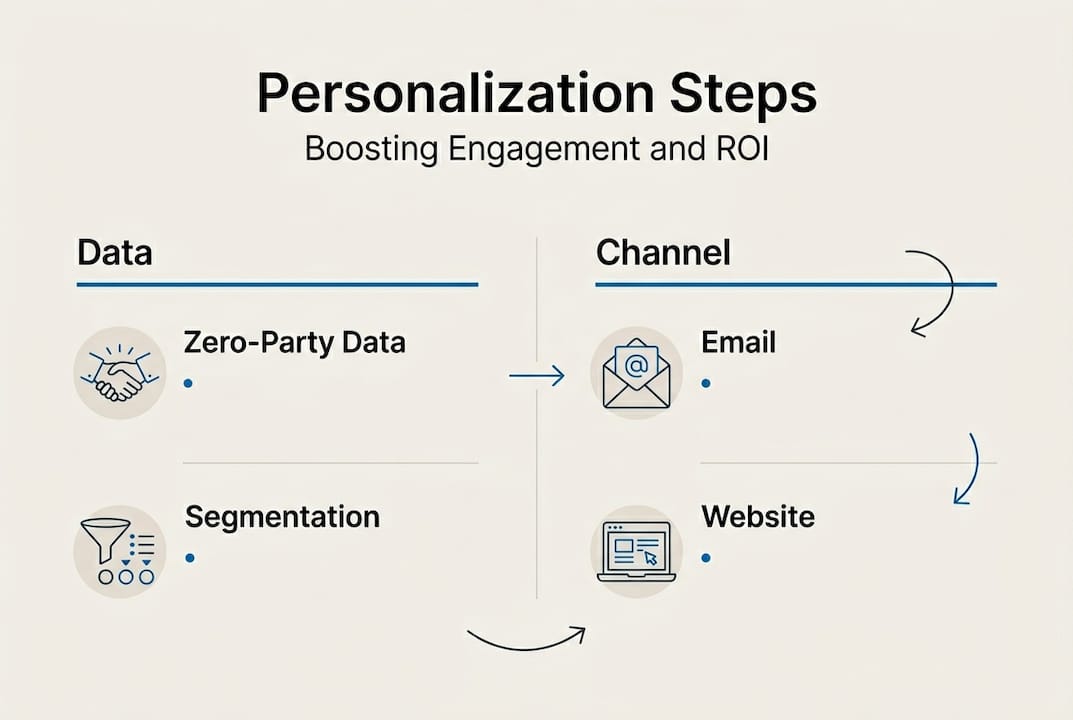
The statistics on personalization effectiveness consistently show that businesses implementing even basic personalization see measurable improvements in engagement and revenue. The key is starting with what you can execute well rather than attempting everything at once. As you build confidence and collect more data, your personalization sophistication naturally increases.
Integrating AI and digital marketing capabilities accelerates this process by automating pattern recognition and content adaptation that would take humans weeks to configure manually.
Testing, validation, and avoiding common pitfalls
Personalization requires continuous testing to optimize results and avoid costly mistakes. A/B testing compares two versions of personalized content to see which performs better. Show half your segment version A and half version B, then measure conversion rates, engagement time, or revenue per visitor. Multivariate testing goes further by testing multiple elements simultaneously, like headline, image, and call-to-action combinations.
Set up your tests with clear hypotheses. Don’t just test random variations. Predict which version will win and why based on your understanding of the segment. Run tests long enough to reach statistical significance, typically at least two weeks or 1,000 visitors per variation. Document results and apply learnings to future campaigns.
Common personalization pitfalls to avoid:
- The creepy factor: 64% of users have experienced invasive personalization that felt like surveillance rather than service. Avoid referencing data users didn’t explicitly share or personalizing in ways that reveal you’re tracking them across contexts.
- Algorithmic bias: Machine learning models can perpetuate existing biases in your data. Regularly audit recommendations and personalized content to ensure you’re not inadvertently discriminating or limiting opportunities for certain segments.
- Cold start problems: New users have no behavioral history, making personalization difficult. Use demographic data and contextual signals to provide relevant experiences until you collect enough behavioral data.
- Data silos: When your email platform, website analytics, and CRM don’t communicate, you can’t create coherent personalized experiences. Invest in integration to create a unified customer view.
- Over-optimization: Showing users only what algorithms predict they’ll like creates filter bubbles and limits discovery. Balance personalized recommendations with serendipitous content.
Pro Tip: Overcome cold start challenges by using contextual personalization for new visitors. If someone arrives from a blog post about email marketing, show them email-related case studies and tools even though you don’t know their history. If they’re browsing on mobile during evening hours, prioritize quick-loading content and mobile-optimized layouts. These contextual signals provide immediate personalization value while you collect behavioral data.
Critical privacy reminder: Every personalization tactic must respect user consent and privacy preferences. If someone opts out of tracking, honor that choice completely. Building long-term trust matters more than short-term conversion optimization. Users who trust your brand become loyal customers worth far more than any single personalized campaign.
Measure what matters. Track conversion rates, average order value, customer lifetime value, and revenue attributed to personalized experiences. Compare personalized segments against control groups receiving generic content. Calculate ROI by dividing incremental revenue from personalization by the cost of tools, data infrastructure, and team time. Most successful personalization programs show positive ROI within three to six months.
For B2B marketers, personalization strategies often focus on account-based approaches where you personalize for specific companies rather than individual users. This requires different data sources and validation metrics but follows the same testing principles.
The future: Human oversight, AI, and evolving best practices
AI is transforming personalization capabilities, but human judgment remains essential. 93% to 94% of marketers agree AI improves personalization, yet only 20% have fully integrated AI into their workflows. The gap exists because effective AI personalization requires human oversight to maintain brand voice, ensure ethical practices, and catch errors that algorithms miss.
AI excels at processing massive datasets, identifying patterns humans would never spot, and adapting content in real time. It can predict which product a customer will want next, determine the optimal send time for each email recipient, and generate personalized content variations at scale. What AI can’t do is understand brand nuance, navigate ethical gray areas, or make judgment calls that require business context.
Your role as a marketer shifts from executing personalization manually to guiding AI systems. You set the strategy, define the guardrails, and validate the outputs. You ensure personalized content aligns with brand values and business goals. You intervene when AI recommendations conflict with customer relationships or long-term strategy.
Evolving best practices for 2026 and beyond:
- Predictive personalization: Move beyond reacting to past behavior toward predicting future needs and proactively serving relevant content
- Cross-channel orchestration: Create seamless personalized experiences as users move between email, website, social media, and physical locations
- Privacy-enhanced technologies: Adopt techniques like federated learning and differential privacy that enable personalization without exposing individual user data
- Emotional intelligence: Incorporate sentiment analysis and emotional context into personalization decisions, not just behavioral data
- Transparent AI: Make personalization algorithms explainable so users understand why they’re seeing specific content and can provide feedback
User expectations continue rising. What felt impressively personalized two years ago now seems basic. Customers expect you to remember their preferences, anticipate their needs, and respect their privacy simultaneously. Meeting these expectations requires continuous adaptation.
Stay current by monitoring industry benchmarks, testing new personalization technologies, and listening to customer feedback. Join communities where marketers share personalization strategies. Attend webinars on emerging AI capabilities. Most importantly, maintain a testing culture where you’re always experimenting with new approaches while measuring results rigorously.
The businesses that win with personalization balance technological capability with human judgment. They use AI to scale what works while keeping humans in the loop to ensure quality, ethics, and brand alignment. Understanding user intent and personalization helps you create experiences that feel helpful rather than manipulative, building the long-term customer relationships that drive sustainable growth.
Unlock more value with expert personalization solutions
Building effective personalization requires expertise across data infrastructure, content strategy, and technical implementation. Many small to mid-sized businesses find that partnering with specialists accelerates results while avoiding costly mistakes. We’ve helped companies implement personalization strategies that increased conversions by 40% and reduced customer acquisition costs by 25%.
Our approach starts with your existing data and tools, then builds personalization capabilities that match your business goals and technical maturity. We design UI/UX experiences that adapt to user behavior, implement AI-driven content recommendations, and create testing frameworks that continuously improve results. When Affinity UA needed to personalize their user acquisition strategy, we developed a data-driven approach that doubled their qualified lead generation within four months. Our PPC optimization services incorporate personalization at every stage, from audience segmentation to dynamic ad creative, ensuring your paid campaigns deliver maximum ROI through targeted, relevant messaging.
Frequently asked questions
What is the fastest way to personalize content for small businesses?
Start with email list segmentation and zero-party data collection, as these methods deliver 36:1 ROI with minimal technical setup. You can implement basic email personalization in days and see results within weeks.
How do I prevent content personalization from feeling invasive?
Be transparent about data collection, minimize what you collect to only what improves experience, and give users control over their preferences. Avoid referencing data users didn’t explicitly share with you.
Which personalization channel offers the best ROI?
Personalized email campaigns provide 36:1 average ROI, the highest of any digital channel, followed by website product recommendations. Start with email to prove value quickly.
Is AI essential for small business content personalization?
AI helps scale personalization efforts but isn’t required initially. Begin with rule-based segmentation and manual content variations, then add AI capabilities when you’re ready to personalize in real time across multiple channels.
How long does it take to see results from personalization?
Most businesses see measurable improvements in engagement within two to four weeks and positive ROI within three to six months. Results depend on your starting point, the sophistication of your approach, and how quickly you can test and optimize based on data.
Recommended
- Essential Content Elements That Boost Engagement
- Designing For Impact: Mastering WordPress Website Design
- Content Trends And Predictions For 2024 | Invisio Solutions
- How To Conduct A Comprehensive Content Audit For Enhanced SEO
- Tips for Crafting Videos That Drive Engagement and Sales | Kickass Online
- Nectar Blog | How to Increase Ecommerce ROI with Data and Creative